

Researchers have demonstrated a way to operate two separate genetic codes at the same time, a development that could speed up work in synthetic biology. The approach sidesteps one of the field’s biggest hurdles: the need to re-engineer an organism’s entire genome whenever the genetic code is altered.
The genetic code is the universal system that life uses to translate the information stored in DNA into specific protein sequences. With only minor variations, every living organism on Earth relies on the same code, which suggests it was already in place in the last common ancestor of all life. Because so many cellular processes depend on it, the code has proven extraordinarily difficult to modify.
Why Changing the Code Is So Hard
Earlier efforts made incremental progress. Scientists managed to add new amino acids to bacterial cells and produced proteins that were one amino acid shorter than usual. But the work was slow and labor-intensive. In some cases, researchers had to re-engineer every single gene in a bacterial genome to make the changes stick.
To understand the challenge, it helps to review how translation works. Within the genome, most genes encode a protein, and the linear arrangement of bases in DNA is translated into the linear sequence of amino acids that forms that protein. Each set of three bases corresponds to a specific amino acid, with three exceptions that signal the end of a protein.
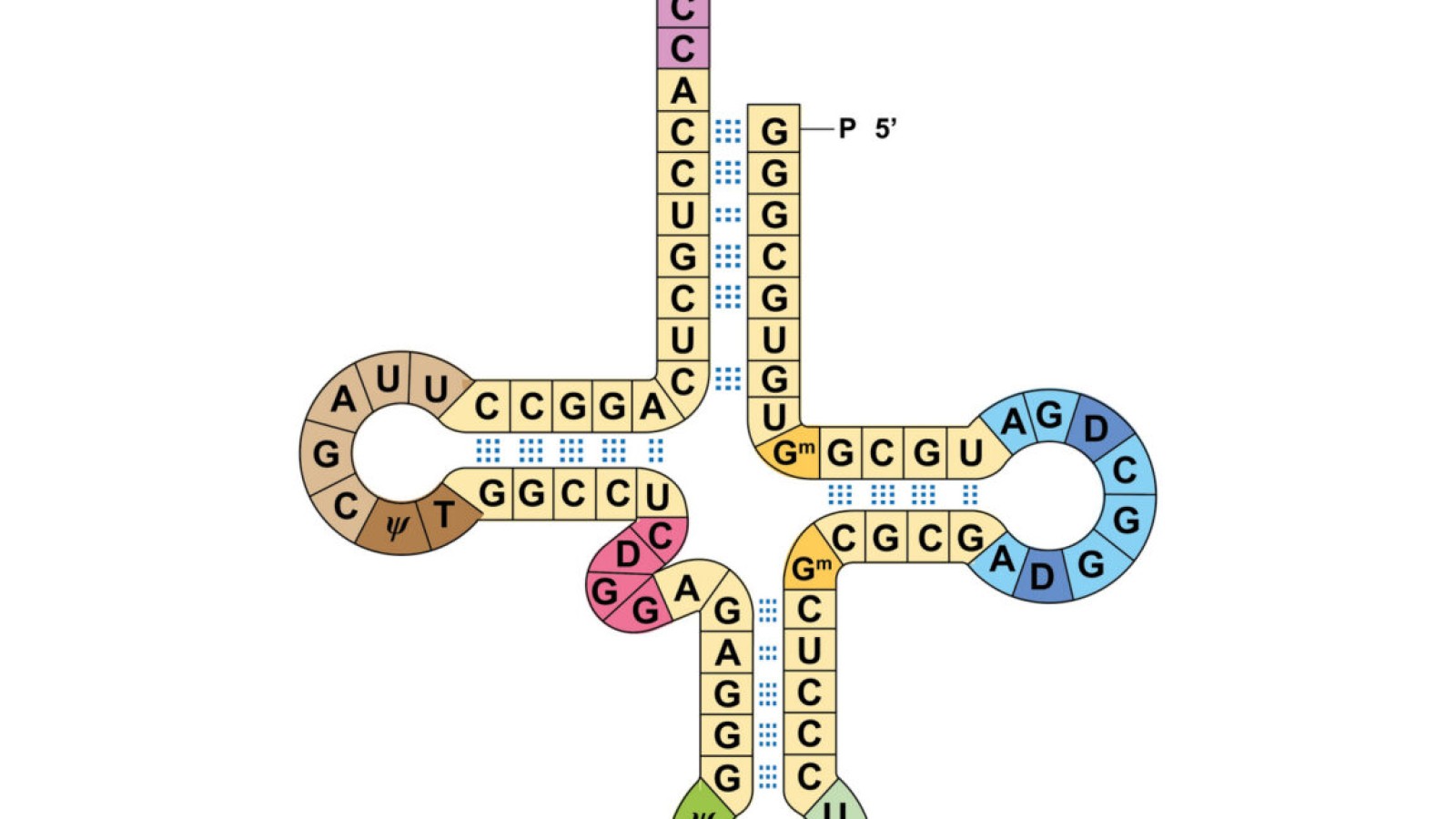
The process is not direct. DNA is first copied into a messenger RNA. A complex of proteins and RNA called a ribosome then latches onto the messenger RNA and translates it one amino acid at a time. That step depends on transfer RNA (tRNA), which folds into a complex structure with two key parts: one side carries three bases that pair with the messenger RNA, while the other end links chemically to the matching amino acid.
The New Approach
Enzymes that link transfer RNAs to the correct amino acid play a crucial supporting role. These enzymes must recognize both the three-base code on the tRNA and the appropriate amino acid, a step often called “charging” a tRNA. To make comprehensive changes to the code, scientists must modify some combination of gene sequences, transfer RNA sequences, and the charging enzymes. Only the ribosome itself can remain untouched.
The difficulty is that intermediate steps usually cannot be taken without causing an entire genome to produce malformed proteins. That constraint has slowed experiments with artificial amino acids and alternative genetic codes for years.
The new method allows two codes to run in parallel, avoiding the need to compensate for altering the code that every protein in a cell relies on. Researchers did not test the system in a living cell, and it could cause problems in that setting. Even so, the technique offers a creative path forward that should accelerate synthetic biology research. The work was not carried out in an actual cell.
Source
Image: arstechnica.com