

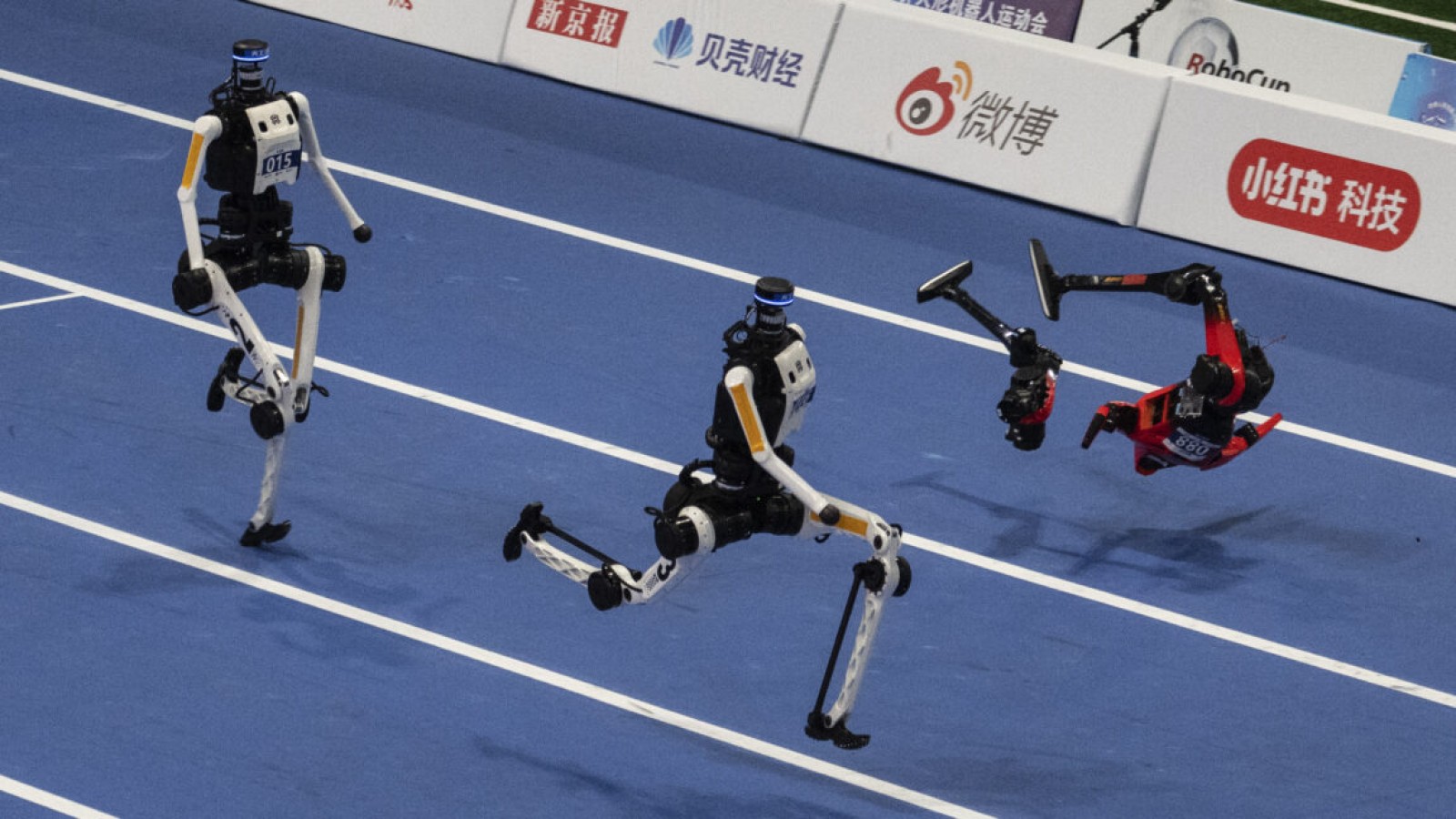
The World Humanoid Robot Games generated a wave of viral clips this year, with sprinting machines topping the human 100-meter record long held by Usain Bolt while others slammed into barriers, toppled over, and in some cases split at the waist in a shower of sparks or burst into flames. The spectacle captured both how far robotics has come and how narrowly these machines are still designed.
The second edition of the event ran in Beijing from August 22 to 26. As with the inaugural 2025 competition, this year’s games pushed humanoid robots to run fast, perform kung fu and dance routines, kickbox one another, and play soccer or table tennis.
From Lagging to Record-Breaking
The 2026 games also added more practical challenges, such as washing and hanging laundry, where the robots trailed typical human working speeds. That focus points to the priorities of the organizers, which include Chinese state media and the Beijing city government, as the country’s robotics industry expands and tests new machines with clear commercial ambitions.
Progress between the two events was significant. In a single year, humanoid robots went from falling short of human record-holders to beating human world marks in the 100-meter sprint and the standing high jump. Dipam Patel, a PhD candidate in computer science at Purdue University and a research assistant at the US Army DevCom Army Research Lab, told Ars that the achievement reflects real advances in whole-body control.
“All of that does display whole body control, because you need to move all the joints, hands, legs, arm, body, everything to accomplish that task,” said Patel, who is also a graduate student member of IEEE. “So there has definitely been a huge push in engineering from where they were last time to this time.”
Built for One Task, Not General Use
Despite the flashy results, the machines remain far from general-purpose autonomous robots able to handle nearly any job. Each was engineered to do a single thing well. The sprinting robots ran in a straight line and could not slow down or continue safely around the track past the finish, which explains many of the dramatic crashes.
“If you cross the finish line, that’s the goal—it doesn’t matter if you stop and it doesn’t matter if you fall into different pieces,” Patel told Ars. “Some companies had different types of robots for different games or different tasks, because they were engineered for that task to be the best in that.”
The races and other high-energy events also serve as marketing. According to Patel, the viral moments give robotics companies a chance to stand out from rivals and attract publicity and investor funding.
One machine built by the Beijing-based firm X-Humanoid drew online attention for winning the small-group 400-meter race with an unusual posture that resembled a shy person hiding behind their hands. Its developers said the robot learned through reinforcement learning trials in simulation to shift from a human-style runner’s arm swing to holding its arms near its face.
Source
Image: arstechnica.com