

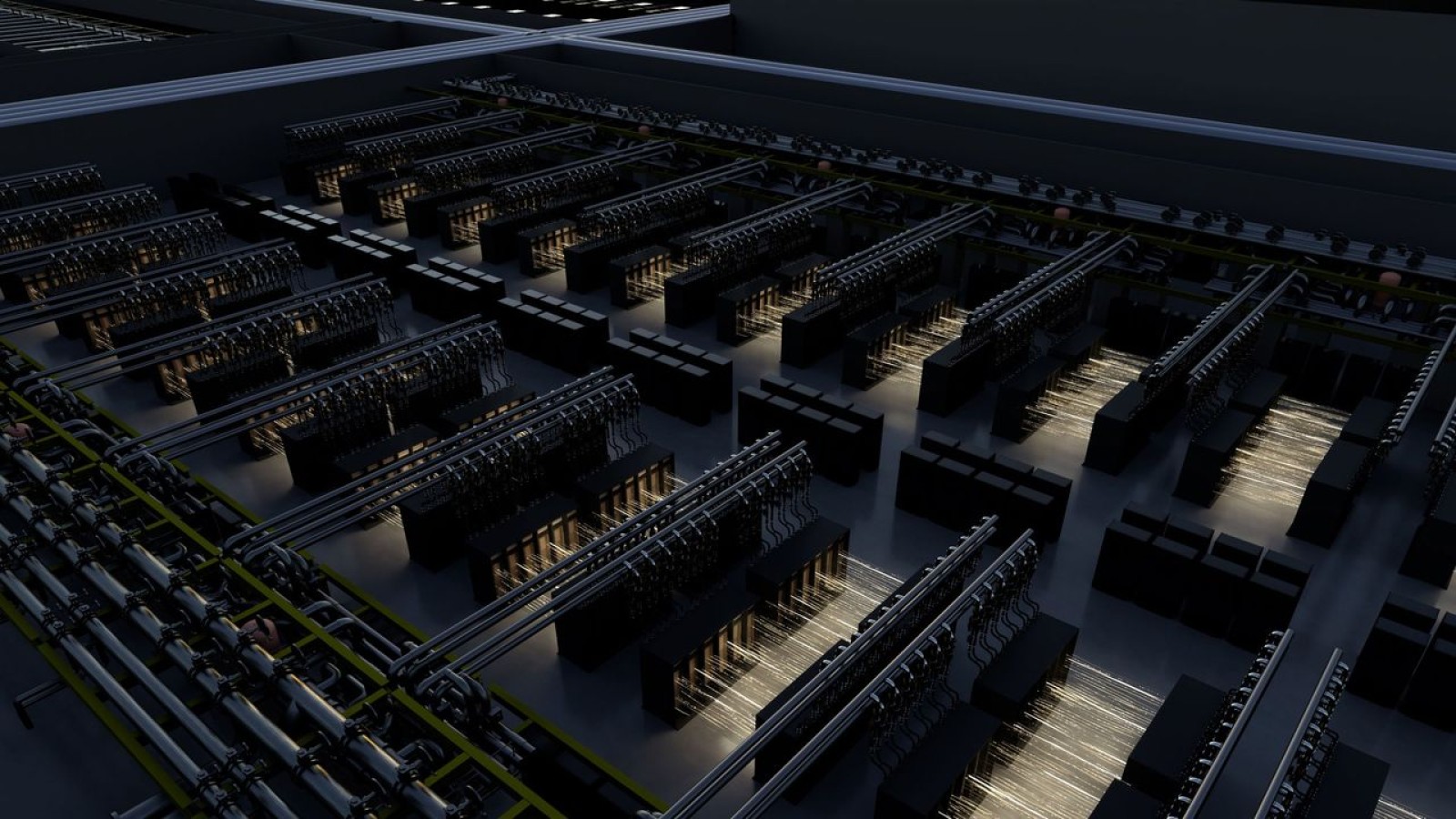
Nvidia DSX MaxLPS aims to squeeze more artificial intelligence compute out of the same amount of electricity, a growing priority as data center capacity increasingly hinges on how much power operators can deliver to each rack. During its Hot Chips 2026 presentation on the Rubin GPU, Nvidia highlighted this hard limit on facility performance and showed what its Vera Rubin NVL72 systems can achieve within a fixed budget.
The pitch centers on a single scenario: a facility with a fixed power budget of 100MW. Nvidia says that combining all of Vera Rubin’s power management technologies with its DSX MaxLPS (Land, Power, Shell) suite of design and site-level dynamic power management tools would let operators provision 40,000 of these next-generation GPUs, or roughly 40 Rubin DGX SuperPODs, inside that 100MW envelope.
The compute claims for Vera Rubin
Within that example budget, Nvidia expects the hardware to deliver up to 2 zettaFLOPS (ZFLOPS) for NVFP4 inference and up to 1.4 ZFLOPS for NVFP4 training. These figures appear to be estimated rather than measured, and real-world workloads are likely to fall well short of peak numbers for a range of reasons. Even so, the underlying message holds: getting the most compute from a limited power supply will require more refined planning, monitoring, and facility management than simply applying an estimated peak power draw to every electrical component.
Moving beyond static power provisioning
According to a companion blog post from Nvidia, operators have traditionally provisioned facilities around fixed, worst-case power peaks per rack. That approach can inflate power budgets and strand allocation in racks that rarely, if ever, use all of it.
Nvidia offered an example: if two racks in a cluster carry different application loads, a static provisioning scheme cannot reroute power to the busier rack. The lighter-loaded system consumes less than its allocation, while the heavily loaded one may still hit the limits of an overly conservative guard band.
The DSX MaxLPS approach is designed to overcome those limits with an intelligent, dynamic scheme that continuously tracks power usage at the chip level, the rack level, and the groups-of-racks level. When unused power is available because of workload characteristics or idle capacity, Nvidia’s Dynamic Power Software control loop can locate that headroom and redistribute it to where it is needed.
The result, Nvidia argues, is that fixed data center power budgets can support more useful compute than static planning allows. The company is positioning the DSX toolkit as ready-made building blocks for data center builders planning the next wave of AI facilities.
Source
Image: tomshardware.com