

The Porsche 911 GT3 Touring occupies a distinctive place in the 911 lineup, offering the driver-focused engineering of a track car without the visual drama of a fixed rear wing. While the range-topping Turbo S emphasizes power, technology, luxury, and all-weather capability, the GT3 has always chased something more elemental: lighter weight, sharper focus, and a finely tuned setup that keeps the driver at the center of the experience.
Porsche has broadened the GT3 formula since the model debuted in 1999. The more extreme GT3 RS arrived in 2003, followed by the more restrained GT3 Touring in 2017 and the GT3 S/C earlier this year. The Touring’s original premise was refreshingly straightforward: take the standard GT3, including its naturally aspirated 4.0-liter flat-six and track-tuned chassis, and swap the fixed rear wing for the deployable spoiler used on the Carrera. The result recaptures the classic 911 silhouette without sacrificing the hardware that defines a GT3.
What Powers the Updated 992.2 Model
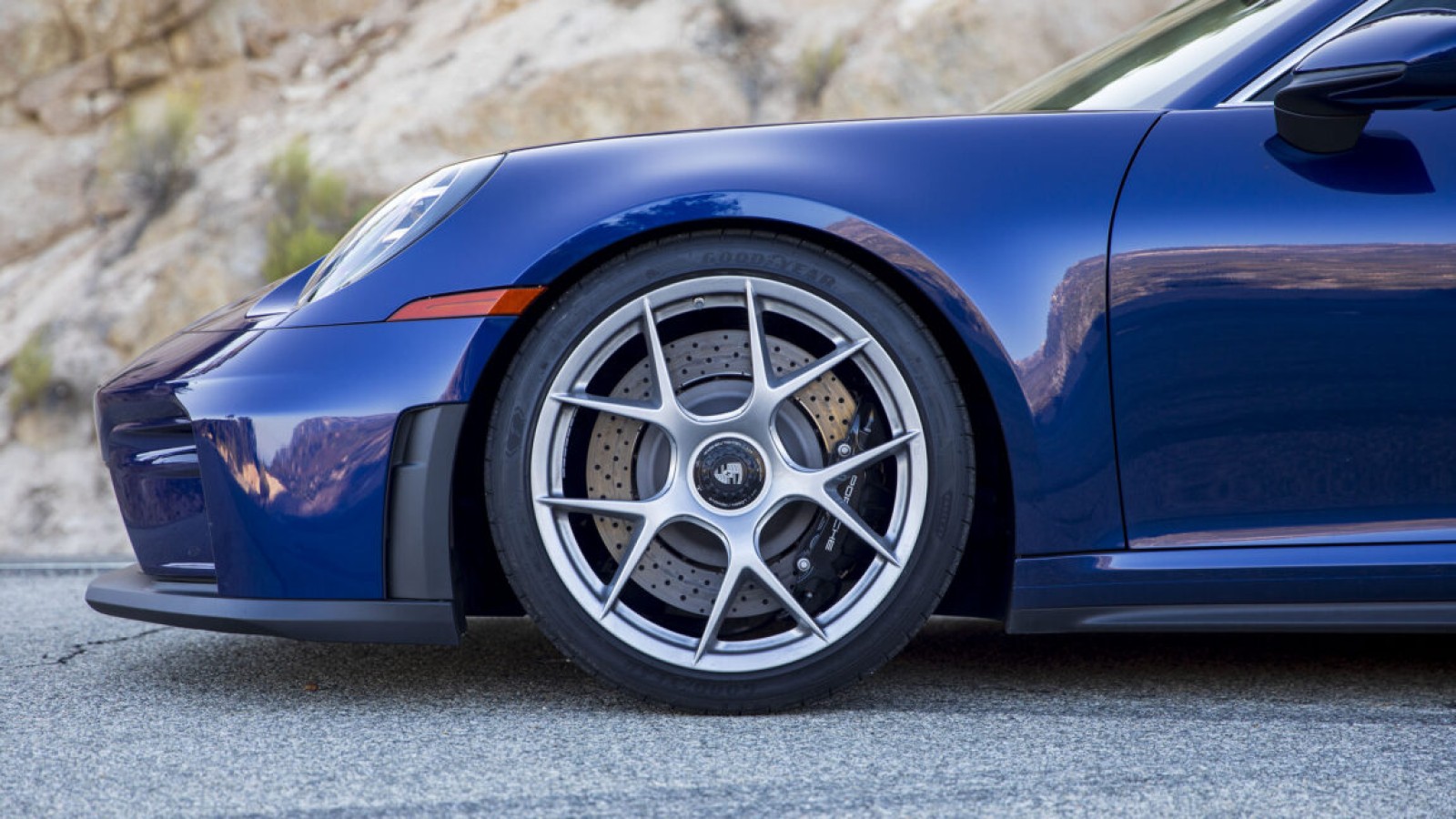
Fresh from its 992.2 mid-cycle update, the latest GT3 Touring stays close to that original concept. Its 4.0-liter flat-six still revs to 9,000 rpm and produces 502 hp (375 kW) and 331 lb-ft (449 Nm), sending output exclusively to the rear wheels through either a seven-speed PDK dual-clutch automatic or a six-speed manual gearbox. Large brakes, rear-axle steering, GT3-specific suspension, an active sport exhaust, and additional road course hardware remain standard.
There is one notable change. That 331 lb-ft figure is 15 pound-feet lower than the outgoing model. Stricter European emissions and noise regulations required Porsche to add two catalytic converters and two gas particulate filters to the exhaust. To offset the resulting flow restriction, engineers borrowed the cylinder heads and camshafts from the GT3 RS to reach a peak horsepower number matching the 992.1 GT3. Porsche also shortened the final-drive ratio by 8 percent, trading a bit of top speed for stronger acceleration.
Real-World Performance and Identity
The changes produce a car that feels every bit as quick in daily driving as its predecessor. The manual GT3 Touring’s top speed drops from 199 to 194 mph (320 km/h to 312 km/h), but its 0 to 60 mph time is unchanged at 3.7 seconds. When equipped with the PDK transmission, the GT3 Touring reaches 60 mph in 3.2 seconds and tops out at 193 mph (310 km/h). The shorter gearing makes the engine’s enormous rev range easier to exploit without requiring speeds likely to attract attention from law enforcement.
The 992.2 update also gives the Touring more of its own identity. Both GT3 variants receive reworked fascias, aerodynamically optimized suspension trailing arms, GT3 RS-derived anti-dive suspension geometry, and revised steering calibration. The Touring retains some of the aerodynamic elements from the more track
Source
Image: arstechnica.com