
The launch window for NASA’s Nancy Grace Roman Space Telescope is about to open, and alongside its primary instrument sits a specialized piece of technology that could reshape the search for other worlds. Tucked inside the observatory is an experimental coronagraph designed to directly capture starlight reflected off a planet’s surface for the first time. NASA hopes the project will lay the groundwork for a future space telescope capable of imaging an Earthlike planet orbiting a sunlike star.
That goal remains beyond the reach of current engineering, which is precisely why the agency is testing the basic technique aboard Roman. “We’ll test them in space for the first time, and we’ll understand what work still is left to go,” says Vanessa Bailey, an astrophysicist at NASA’s Jet Propulsion Laboratory and the coronagraph’s instrument scientist.
How the Coronagraph Blocks Starlight
At its core, a coronagraph works like a science-focused sunshade, blocking the light of a bright star to reveal a fainter object hidden in the glare. Similar instruments have flown before, since both the Hubble and James Webb space telescopes carry coronagraphs. Roman’s version is far more advanced, largely because of adaptive optics, a technology that deforms a telescope’s mirror to cancel out light distortions.
The challenge is enormous. NASA compares the task of Roman’s coronagraph to photographing a firefly perched next to a floodlight from across the country. “Any little bit of starlight that gets in the wrong place could just destroy a whole portion of the image,” says Margaret Turnbull, an exoplanet scientist at the SETI Institute in California, who leads a Roman coronagraph science team.
Adaptive optics is already standard on advanced ground-based observatories, including the Very Large Telescope in Chile and the twin Keck Observatory in Hawaii. On the ground, the technology counters interference from Earth’s shifting atmosphere to produce sharper images. Space telescopes have not traditionally needed it, since they operate above the atmosphere, but none have attempted to observe old, cool planets illuminated only by reflected starlight.
Deformable Mirrors and Precision Masks
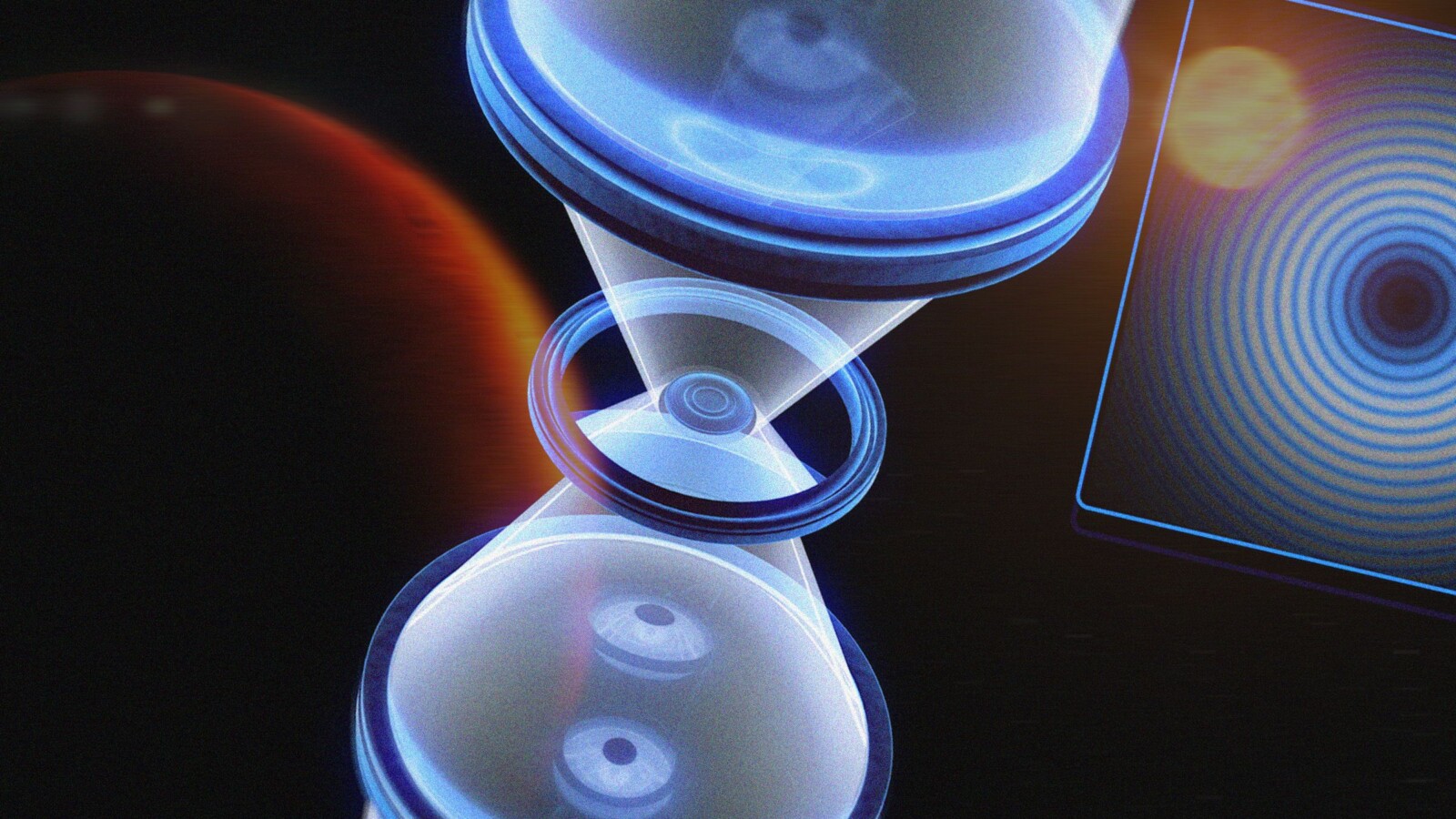
The key to Roman’s coronagraph lies in two palm-sized mirrors, each fitted with roughly 2,300 tiny actuators that expand when a small jolt of electricity is applied, reshaping the mirror by minute amounts to reverse interference. It marks the agency’s first time flying active deformable mirrors in space.
The mirrors cannot work alone. The system relies on highly sensitive detectors that amplify the signal from individual photons, a necessity given how few photons the instrument will collect from any given planet. It also depends on the heart of any coronagraph: the star shades. In Roman’s case, these are a set of finely detailed masks that Bruce Macintosh, an astronomer who leads the University of California Observatories and a Roman coronagraph science team, describes as “beautiful, complicated shapes” unlike anything currently in space. By contrast, he notes that the Hubble masks rely on brute force, amounting to a simple piece of metal that blocks the light.