

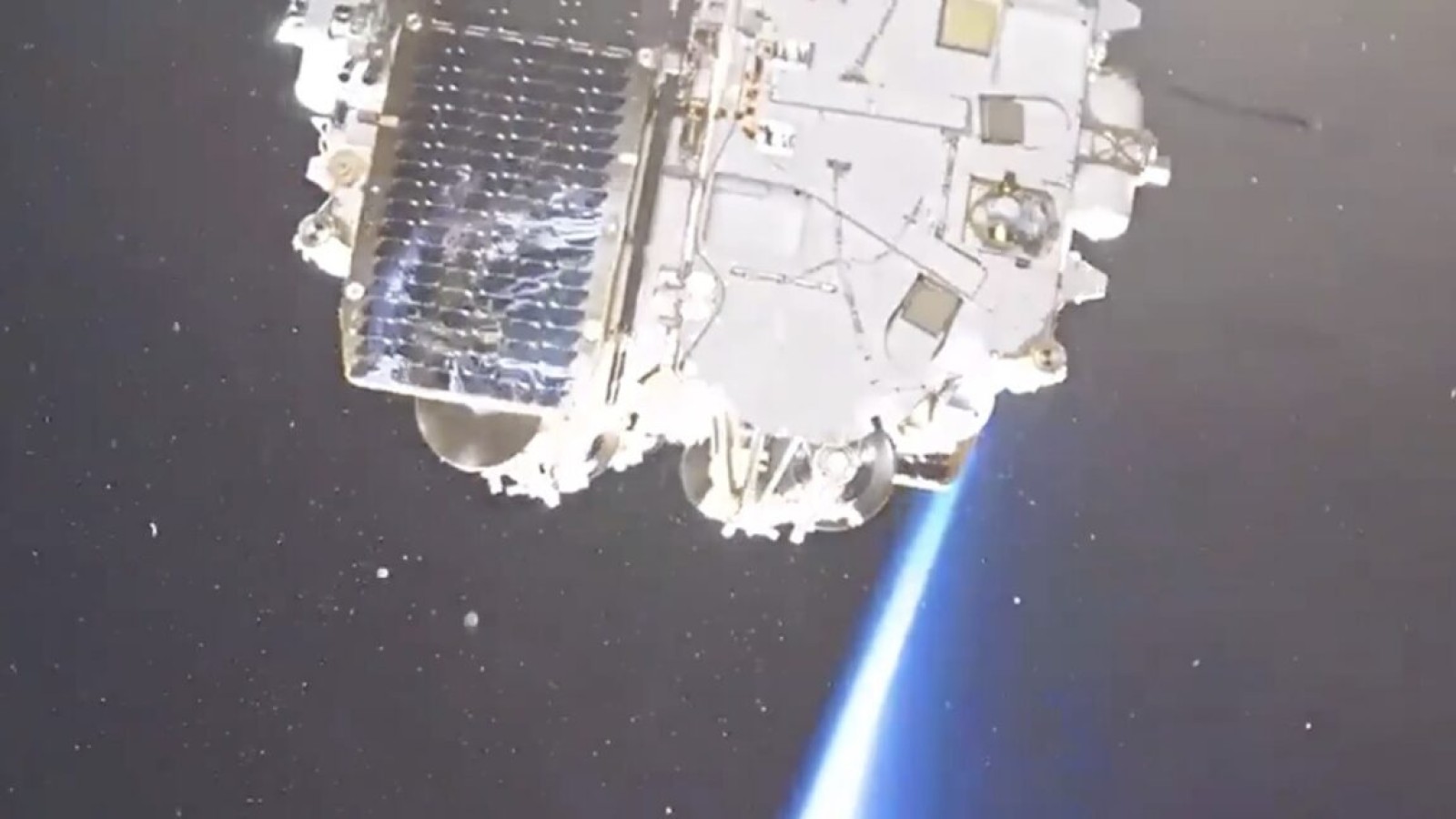
Rassvet, Russia’s answer to SpaceX’s Starlink, is off to a slow beginning as its first operational satellites struggle to reach their intended orbits. The program, managed by Bureau 1440, began launching operational spacecraft earlier this year but has already recorded several apparent failures.
Two launches, the first in March and a second in July, have placed 32 Rassvet satellites into low-Earth orbit. That figure represents roughly 10 percent of the approximately 300 spacecraft Russia hopes to deploy by the end of next year to serve military and civilian users. Bureau 1440’s longer-term target is a constellation of 924 satellites by 2035.
None of the Satellites Have Reached Their Target Orbit
So far, not one of the 32 satellites has climbed to its designed operating altitude of 500 miles (800 kilometers). The rockets released the spacecraft much closer to Earth, with each satellite expected to use its own plasma engines to raise its orbit over the following months.
The highest altitude achieved to date is a little more than 300 miles (500 kilometers). Twelve of the 16 satellites from the March launch have settled at that altitude, according to an assessment published Monday by the Institute for the Study of War. A chart from independent launch tracker Jonathan McDowell suggests one additional satellite may soon rise above 300 miles.
One satellite from the March batch never performed significant maneuvers and reentered the atmosphere in June. Two others have not raised their altitude in the past two months, a sign they may also be experiencing problems.
The July batch shows similar issues. Two satellites never maneuvered after launch and appear headed for reentry, according to Anatoly Zak of RussianSpaceWeb.com. Zak reported that 11 of the 16 July satellites were “noticeably climbing” by early August, while three more appeared to stop maneuvering after initial attempts to lift their orbits.
How the Failure Rate Compares
At least three of the first 32 Rassvet satellites likely suffered outright failures. Some early anomalies were anticipated. SpaceX’s first batch of 60 Starlink prototypes saw about 5 percent fail almost immediately, with the group eventually reaching a failure rate near 13 percent, according to McDowell. The next 420 Starlink satellites failed at roughly 3 percent, and the current Starlink Version 2 generation has a failure rate of about 0.01 percent.
Similar growing pains have affected other operators. The US Space Development Agency is building its own constellation of data relay satellites for missile targeting and command and control. Some of its first 42 operational satellites encountered thermal and propulsion problems after launching last year, and they took longer than expected to raise their orbits.
In its Monday assessment, the Institute for the Study of War noted that the second batch of Rassvet satellites appears to be following a pattern comparable to the first, with a portion of the fleet climbing while others stall or reenter.
Source
Image: arstechnica.com