
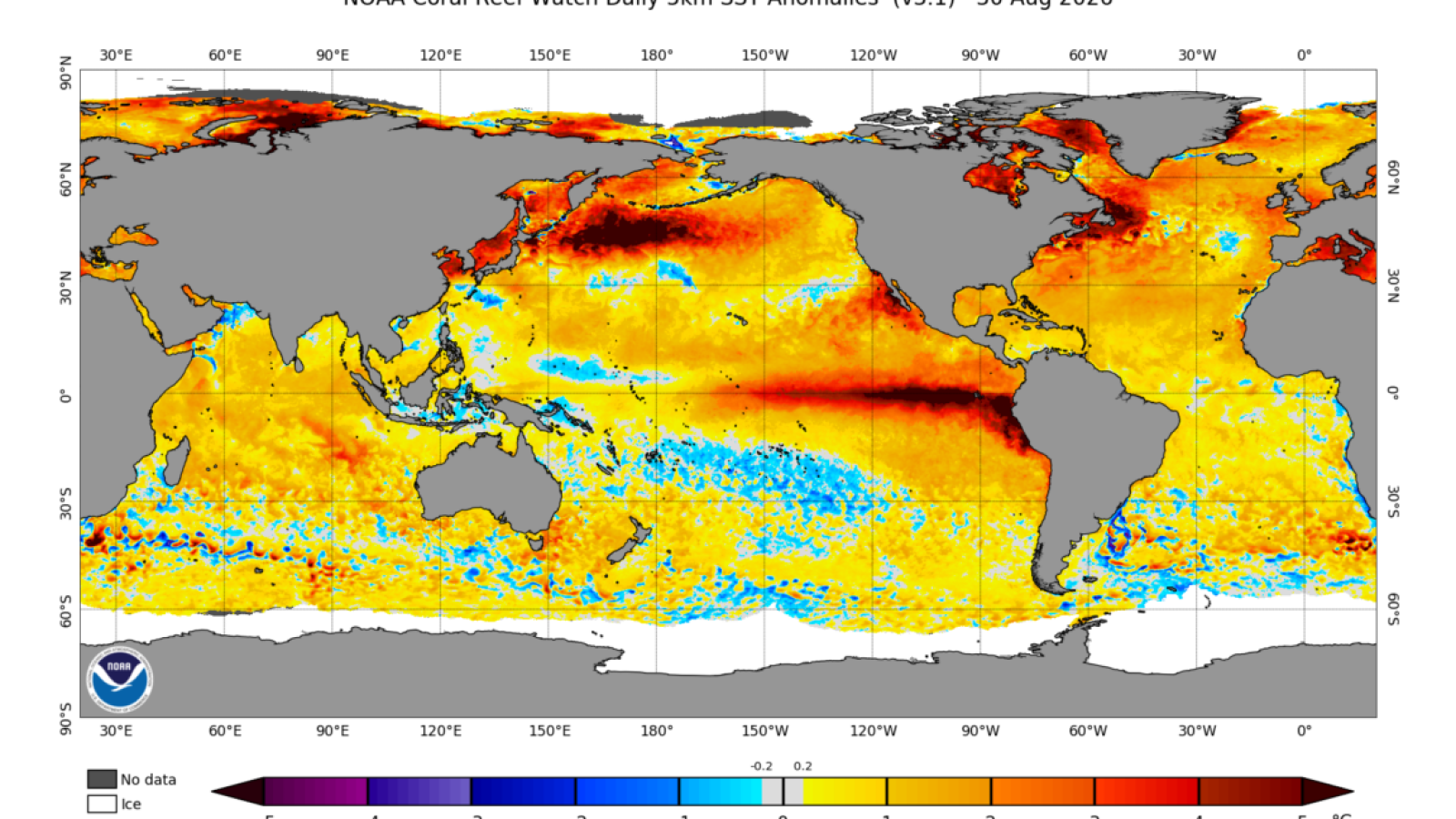
El Niño in the eastern Pacific is more intense today than at any time in the past millennium, according to new research that reconstructed a thousand-year ocean temperature record from Galápagos corals. The finding offers some of the clearest evidence yet that human-driven warming may be amplifying the planet’s largest source of year-to-year climate swings.
Every few years, El Niño and its cool counterpart, La Niña, redistribute rainfall across the tropics, dry out Australia, flood parts of Peru, and reshape weather across much of the globe. Together they form the warm and cold phases of a single system known as the El Niño–Southern Oscillation, or ENSO. That system is the largest driver of annual climate variation on Earth, and its swings now sit atop steadily rising global temperatures.
Until now, scientists could not confirm whether global warming was making those swings more extreme. Climate models disagreed with one another, and direct instrument records were too short to separate a clear trend. “We’ve been seeing some very strong El Niño events in the late 20th and early 21st century, and what we didn’t know was how unusual those are,” said Julie Cole, an environmental scientist at the University of Michigan.
A Limestone Thermometer From the Galápagos
To extend the record, Cole’s team analyzed fossilized Galápagos corals, which sit at the center of the eastern Pacific ENSO pattern where the strongest events hit hardest. The location is also one of the few places to find fossilized corals in the region. “The Galápagos are located at 90 degrees west, and you have to go all the way to 160 degrees west to find another island in that near-equatorial zone,” Cole said.
Corals there grow one to two centimeters a year, building a calcium carbonate skeleton whose chemistry reflects the water it formed in. Researchers measured the strontium-to-calcium ratio and different oxygen isotopes, both of which track temperature. Sampling coral cores millimeter by millimeter yields more than a dozen readings per year, effectively a monthly temperature log for each colony.
Living colonies cover recent decades and can be checked against instrument data. Older history comes from dead coral heads dated using uranium-thorium methods, accurate to within a few years even 500 years back. Some specimens washed up on beaches were 100, 200, or 900 years old, or older. The full dataset produced 28 time-separated series from five islands, reaching back to roughly 1100 CE.
A Modernized ENSO
Against that long baseline, the past four decades stand out sharply. Temperature variability since 1984 runs 36.5 percent higher than during the preindustrial stretch from 1000 to 1850 CE, and 16.2 percent higher than during the period from 1851 to 1982. All three intervals are statistically distinct, and the trend points only upward.
“The events don’t look anything like what we see in the pre-industrial era,” Cole said. “That was exciting. And a little surprising, actually.” The modern El Niño events in the eastern Pacific have reached a level of intensity with no match anywhere in the thousand-year coral record.
Source
Image: arstechnica.com