
Battery swapping has struggled to gain traction across much of the world, but Canadian auto parts giant Magna International sees a viable path to scale in India. The country’s millions of two- and three-wheelers, combined with a rapidly expanding delivery economy, create a distinct set of economics that could make the model work.
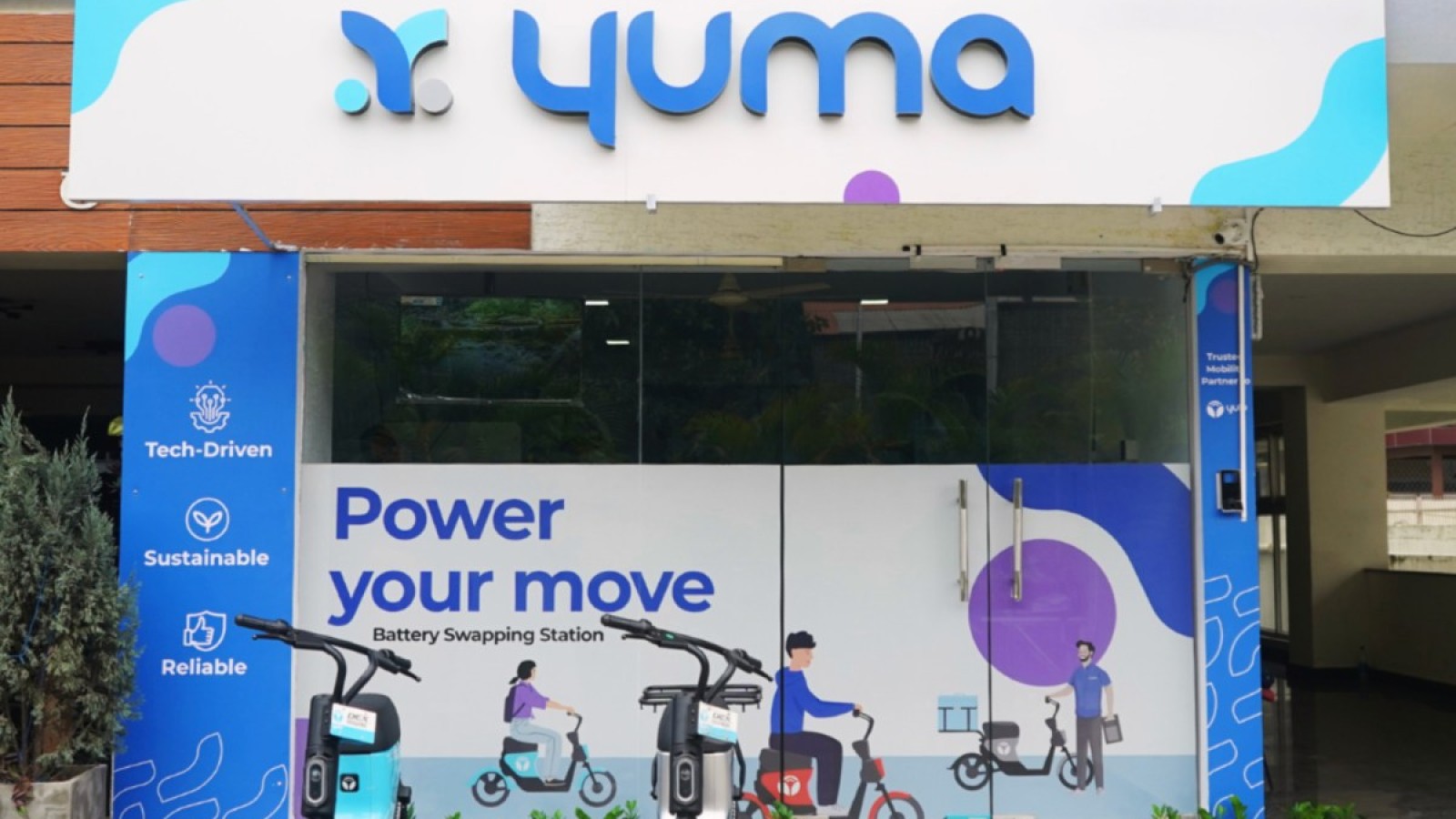
Magna is now investing an additional EUR 30 million into Yuma Energy, a Bengaluru-based company that runs a battery-swapping network for electric two- and three-wheelers. Yuma, which spun out of Indian mobility startup Yulu in early 2023, has logged more than 60 million swaps to date and currently has roughly 100,000 batteries deployed across its network.
The fresh capital increases Magna’s ownership beyond the 51% it acquired when the joint venture was formed, according to Yuma managing director Muthu Subramanian. As a result, Yulu’s 49% share will be diluted, though Subramanian declined to reveal the updated ownership split. Yulu and Yuma remain Magna’s only startup investments in India. In 2022, the automaker committed a combined EUR 66 million to both businesses, directing EUR 22 million to Yulu and EUR 45 million to the battery-swapping venture.
Betting on India’s Gig Economy
Magna’s latest bet leans heavily on India’s growing gig economy. Delivery riders lose valuable time, and income, while charging their EVs. Subramanian estimates that only about 10% to 15% of vehicles used by gig workers in India are currently electric, leaving substantial room for operators like Yuma as more riders shift away from gasoline-powered vehicles.
“With Indian gig workers’ high runtime on a daily basis, an EV makes absolute sense in terms of cost of ownership,” Subramanian said. “Uptime is important.”
Yuma is focused on high-mileage riders, arguing that swapping outperforms fast charging in practicality. A battery can be exchanged in under two minutes, Subramanian noted, while even a 20- or 30-minute fast charge pulls a rider off the road and demands more space and power to serve multiple vehicles simultaneously.
Building Ahead of Demand
Delivering that convenience carries significant cost, since Yuma must keep its batteries and swapping infrastructure ready before enough riders arrive to fully utilize them. “It’s a capital-intensive business, and the unit economics will play out at scale,” Subramanian said.
Yuma is not yet profitable, although some of its older swapping stations are already EBITDA-positive. The company operates more than 400 stations with over 2,500 charging units and closed the financial year in March 2026 with about ₹1 billion, roughly EUR 9 million, in revenue. It aims to reach EBITDA break-even within the next two quarters.
To get there, Yuma plans to keep building ahead of demand. The company will direct the bulk of Magna’s investment toward expanding its swapping infrastructure and doubling its fleet of roughly 100,000 batteries over the next 12 to 18 months.
Yulu still accounts for the vast majority of Yuma’s 60 million lifetime swaps, but that dependence is easing.
Source
Image: techcrunch.com