
Astronomers have identified a striking new celestial object called a black hole star, one of several science discoveries that emerged in recent research. The object is roughly the size of a large star but generates far more energy than nuclear fusion could ever produce, rivaling the output of an active black hole.
Astronomers Confirm a “Black Hole Star”
The story began in 2024, when researchers sifting through data from the James Webb Space Telescope spotted hundreds of mysterious little red dots. These objects, thought to be baby quasars, existed when the Universe was only a few hundred million years old. One in particular stood out: it was extremely red and very bright, yet its properties matched no known astrophysical object.
Writing in the journal Nature, astronomers concluded the red dot is a black hole star. At first, the team suspected dust was responsible for the intense red color, but the light disappeared entirely below certain wavelengths, a phenomenon known as a Balmer break that usually signals a stellar atmosphere. This was the deepest such break ever recorded, and the spectrum showed no metals or elements beyond hydrogen and helium.
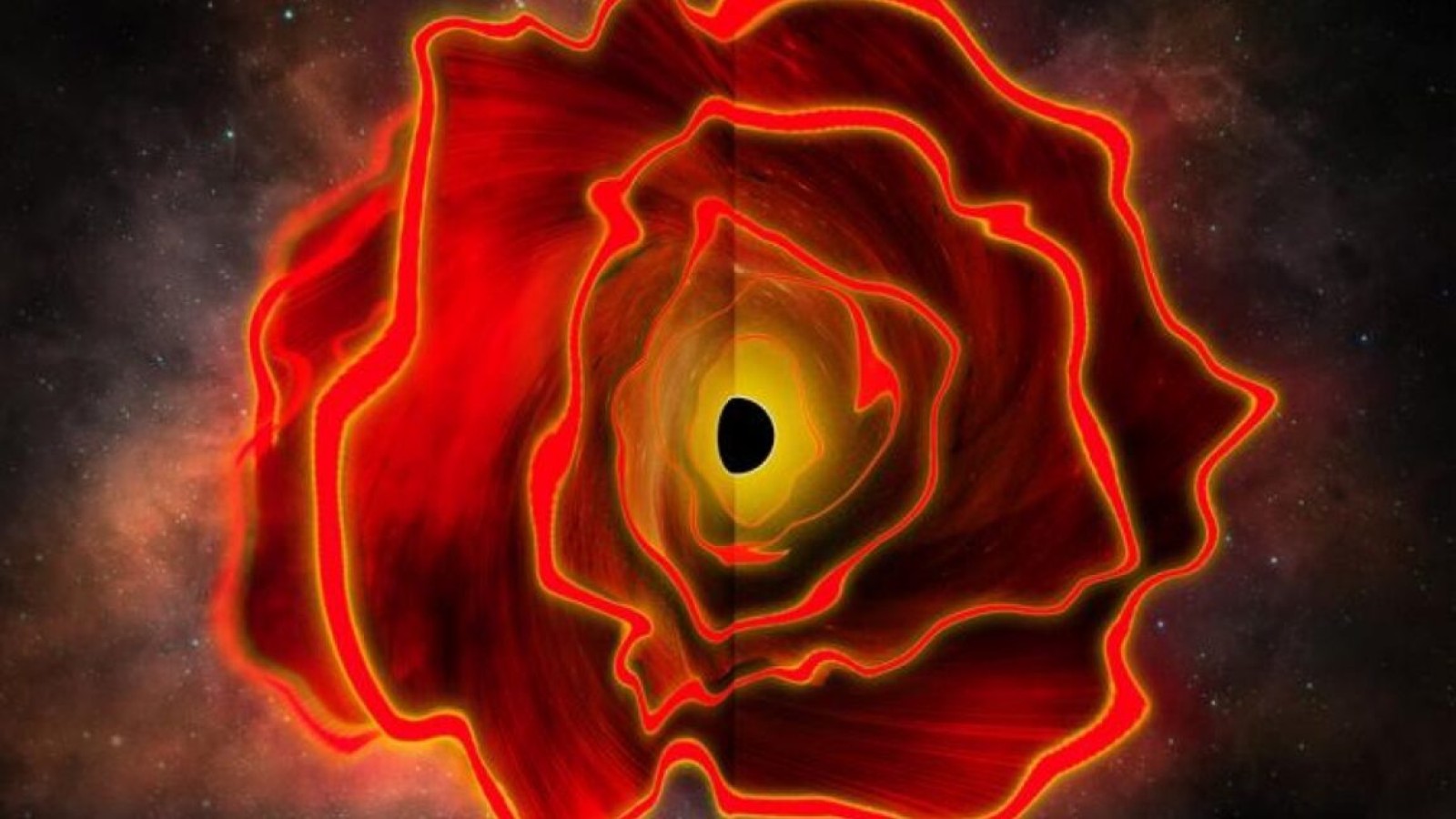
Computer simulations pointed to a powerful energy source wrapped in a dense hydrogen cocoon. The only object capable of shining 100 billion times brighter than a star would be an active accreting black hole. The team named the object MoM-BH*-1 and described it as a central black hole of about 100 solar masses surrounded by a hydrogen cocoon the size of our solar system. Two more black hole stars have since been identified, and researchers hope these objects will help explain how supermassive black holes formed so quickly after the Big Bang.
Turning Plastic Bottles Into Edible Cookies
Plastic pollution remains a serious environmental challenge, and microbes are giving scientists new tools to address it. Researchers at Southern Illinois University have developed a method that uses microbes to break down polyethylene terephthalate (PET), the plastic used in beverage bottles, and convert it into an edible cookie.
The team suggests the approach could benefit astronauts on deep-space missions, crews aboard submarines, or future colonists living on the Moon or Mars, where food resources are scarce and recycling waste into nutrition would be valuable. The work illustrates how microbial processing can transform a common pollutant into a usable product.
These findings were among several noteworthy studies collected in a monthly research review, which also highlighted how whale calls connect to Einstein’s special theory of relativity and how avocado tree flowers switch sex during the day. The black hole star research was published in Nature in 2026, under DOI 10.1038/s41586-026-10846-4.
Source
Image: arstechnica.com