
The BepiColombo mission has passed a critical milestone in the final phase of its eight-year trek to Mercury, the scorching, iron-rich planet at the innermost edge of the Solar System. The roughly EUR 2 billion robotic science mission is led by the European Space Agency, with contributions from Japan and the United States.
Since launching in 2018, the spacecraft has spiraled steadily closer to the Sun using a mix of plasma propulsion and repeated flybys of Earth, Venus, and Mercury. Those maneuvers adjusted its speed and gradually steered it toward a decisive Mercury encounter later this year. In total, the trajectory demanded an unprecedented nine planetary flybys, also known as gravity assists, to line up the chance to enter orbit around Mercury.
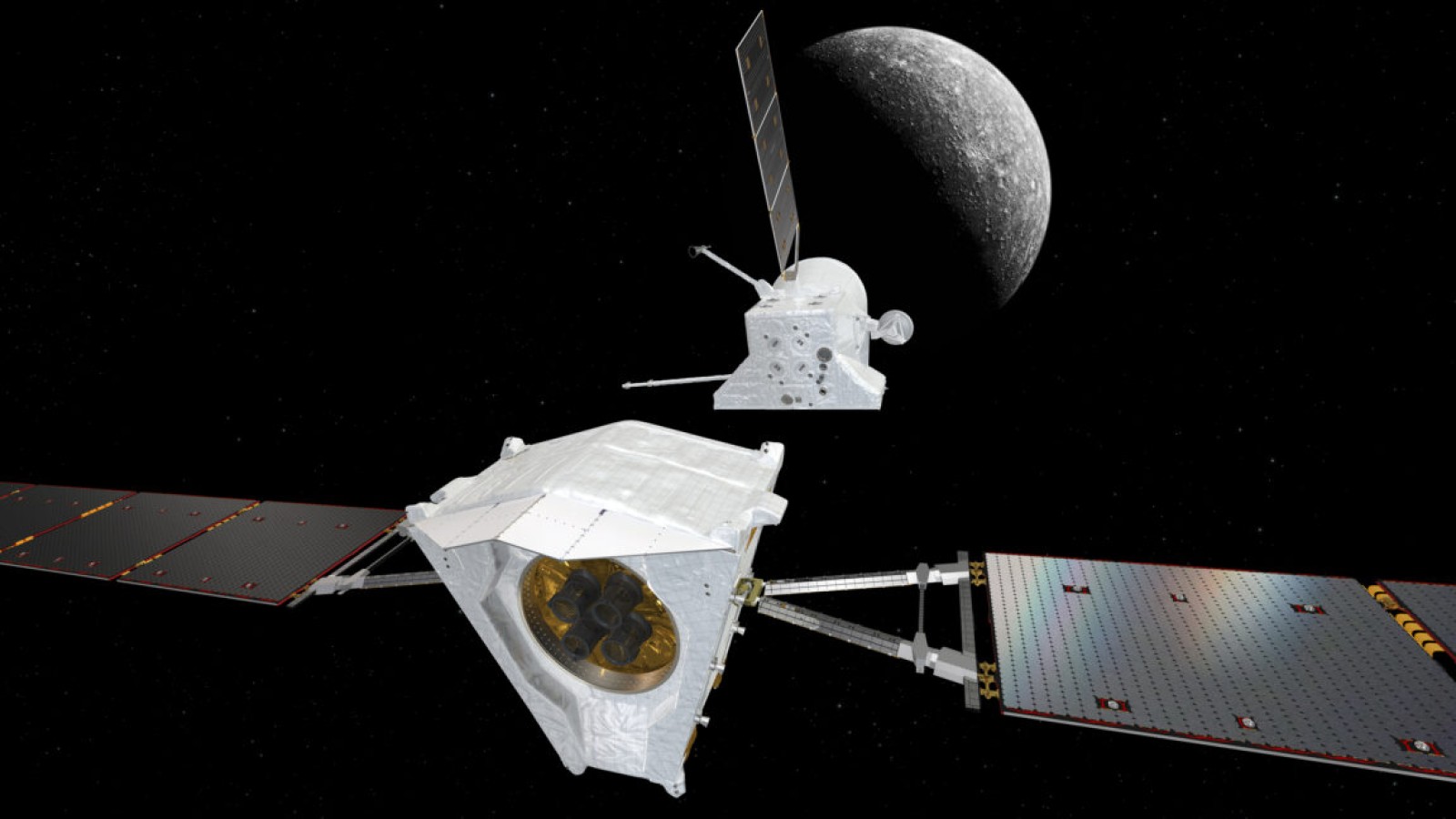
BepiColombo also carried the most powerful electric propulsion system ever flown into deep space, relying on four gridded ion thrusters to reshape its orbit around the Sun between flybys.
Dropping the Transfer Module Before Orbit
Now just months from its destination, the spacecraft no longer needs its plasma engines. On Thursday, BepiColombo jettisoned the section housing the ion thrusters, known as the Mercury Transfer Module. That component had generated power and provided propulsion throughout the eight-year cruise, but it was no longer required and had to be discarded before the spacecraft slips into orbit in November.
BepiColombo is unusual because it is actually a stack of three spacecraft: the Mercury Transfer Module and the Mercury Planetary Orbiter, both built in Europe, plus Japan’s Mercury Magnetospheric Orbiter, nicknamed Mio. With the transfer module gone, the European and Japanese orbiters continue traveling together. The two will separate from each other in December, shortly after reaching their initial orbit around Mercury. Each orbiter carries its own instruments for scientific observations, while the transfer module served as dead mass once its work was done.
Operating in a Punishing Environment
Nothing like this controlled disassembly has ever been attempted in an environment as harsh as the space near Mercury. Separation of the Mercury Transfer Module took place 39 million miles (63 million kilometers) from the Sun, less than half of Earth’s distance, amid extreme temperatures and intense solar radiation.
Ignacio Tanco, head of inner Solar System mission operations at ESA, told reporters the challenge is “equivalent to launching a new spacecraft,” carrying “considerable risk” that something could go wrong. Releasing the transfer module required the remaining spacecraft to take over power generation, propulsion and pointing, and thermal control, a major concern while flying so close to the Sun.
A monitoring camera aboard the Mercury Transfer Module captured a view of Mercury’s cratered surface during a flyby on January 8, 2025. BepiColombo is scheduled to enter orbit around Mercury in November 2026, with the European and Japanese orbiters separating in December.
Source
Image: arstechnica.com