
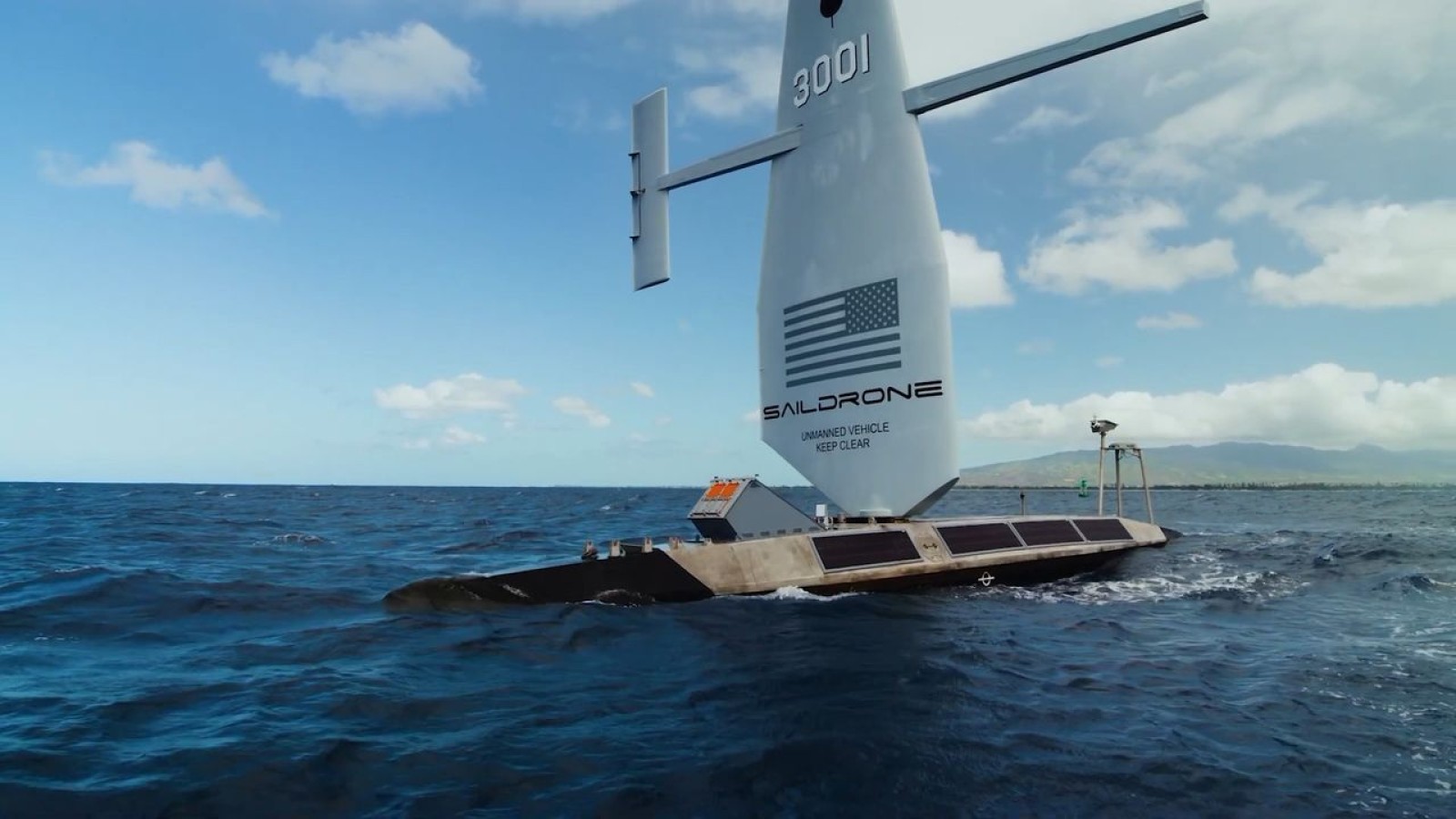
The US Navy has successfully fired missiles from a sail-powered autonomous vessel for the first time, marking a new milestone for unmanned combat systems in the Pacific. The platform, the Saildrone Surveyor SD-3001 Unmanned Surface Vessel (USV), was developed together with Lockheed Martin to carry lethal weaponry, and it completed live-fire testing during the Rim of the Pacific (RIMPAC) 2026 exercises.
During those exercises, the drone launched two Joint Air-to-Ground Missiles (JAGM) while operating alongside the USS Theodore Roosevelt (CVN-71) Carrier Strike Group. The same trials also confirmed the vessel’s ability to perform passive electronic warfare tasks.
How the Live-Fire Test Worked
At RIMPAC, the USS Theodore Roosevelt Carrier Strike Group gained access to the Saildrone as a combat asset for the first time. Operating under the Navy’s Adjunct Remote Engagement System (ARES), the sea drone launched two combat-proven JAGM missiles.
Each JAGM uses two independent guidance modes: a semi-active laser and millimeter-wave radar. By combining both, the missile can engage targets in all weather conditions, including low-visibility maritime environments where clear line of sight is limited.
Integrating the vessel into the Navy fleet environment so it could work with ARES was a central goal of the program, and that capability was demonstrated during this year’s exercises.
A Fast Development Timeline
The pace of the project stands out. Work on the collaborative effort began in October 2025, with the partners aiming to combine Saildrone unmanned surface vehicles with Lockheed Martin’s combat-proven effectors. Both elements were already operationally proven, yet bringing them together within roughly six months and completing a successful live-fire demonstration is a notable accomplishment.
The trials also highlighted the long-range, long-endurance drone’s electronic warfare potential. The vessel coordinated its sensors with an MH-60S helicopter to detect, classify, and identify a surrogate threat during the exercises.
What Comes Next
Lockheed Martin, Saildrone, and the Navy have additional tests and trials planned for the seafaring USV. Saildrone said the SD-3001 is now well on its way to its next mission, with development work alongside Lockheed Martin continuing.
Officials describe the demonstration as having reduced the risk of larger payload integrations planned for the larger Saildrone Spectre. That vessel is expected to carry significantly larger containerized capabilities, including the Lockheed Martin Mk 70 launcher and the SURTASS Towed Array. The successful JAGM launches at RIMPAC 2026 mark the first time the Navy has fired missiles from a sail-powered drone.
Source
Image: tomshardware.com