
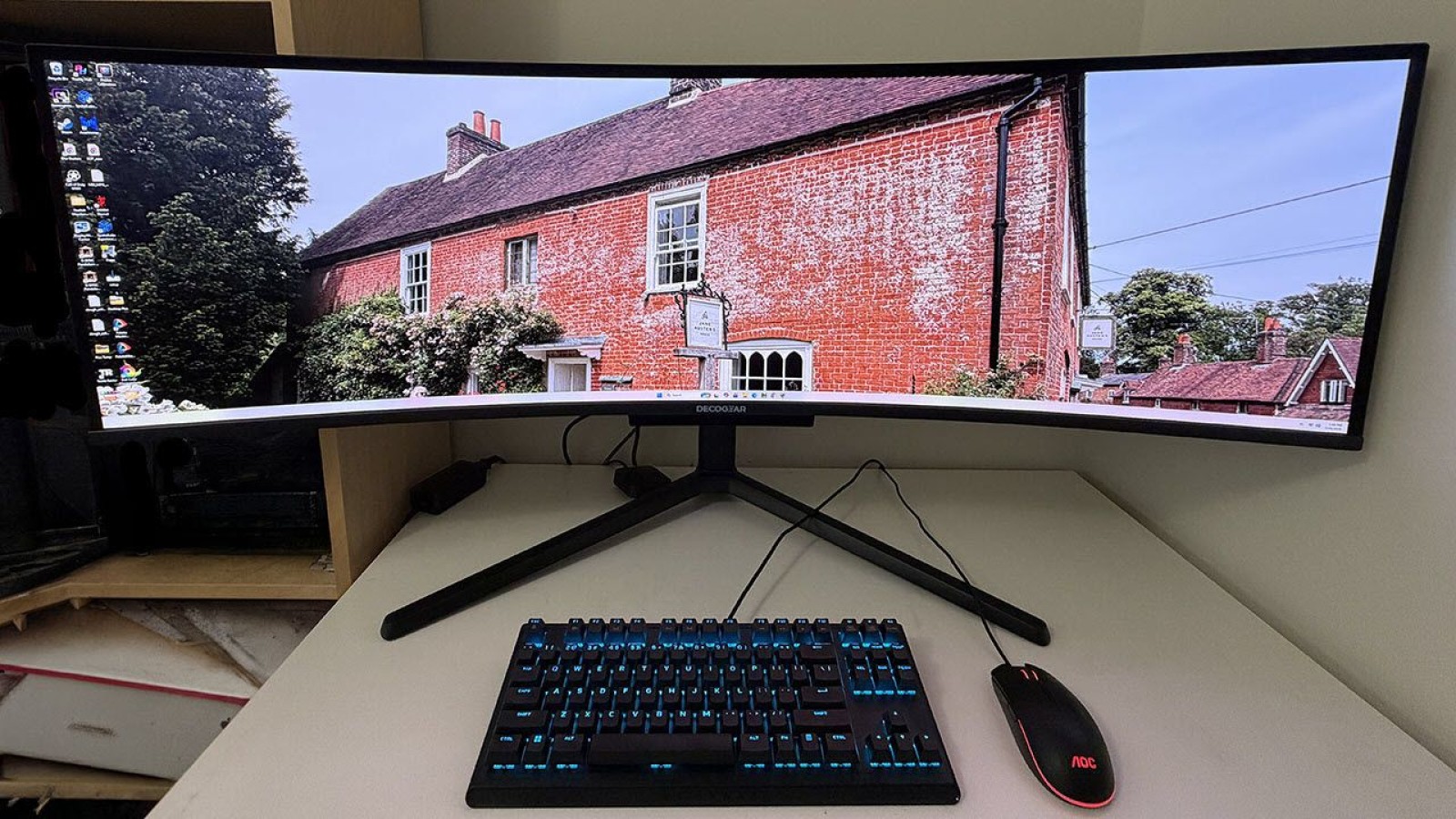
The Deco Gear DG49OLED240 tackles a familiar problem for anyone chasing more screen space: the dividing line between two monitors. Running dual 27-inch QHD panels is a common and affordable way to expand your desktop, but the bezels always remain visible. No amount of flush framing makes that gap disappear entirely.
An ultra-wide display solves this. A single 49-inch 32:9 panel is the exact equivalent of two 27-inch 16:9 QHD screens side by side, minus the seam in the middle. Add a curve, and you get a monitor well suited to productivity, gaming, and simulation work. The DG49OLED240 lands on your desk for EUR 1,056, delivering a 5120×1440 QD-OLED panel, a 240 Hz refresh rate, Adaptive-Sync, HDR400, and wide-gamut color.
Specifications and Panel Performance
The DG49OLED240 uses a Quantum Dot Organic Light Emitting Diode (QD-OLED) panel measuring 49 inches with a 32:9 aspect ratio and an 1800mm curve radius. It runs at 5120×1440 resolution and 240 Hz, with both FreeSync and G-Sync compatibility. Color depth is native 10-bit covering the DCI-P3+ gamut, and it supports HDR10 and DisplayHDR 400. Response time is rated at 0.03ms.
Connectivity includes two DisplayPort 1.4 inputs, one HDMI 2.1, and one USB-C, plus a 3.5mm headphone output and USB 3.0. Audio comes from two 5-watt speakers paired with a 10-watt woofer. The panel weighs 20.9 pounds, measures 6.7 inches thick, and carries a one-year warranty. Power consumption is rated at 71 watts with brightness set to 200 nits.
In testing, the QD-OLED panel covered 112% of DCI-P3, exceeding many 34-inch 21:9 screens. It measured well out of the box and improved further after a few calibration adjustments. Light output reached roughly 430 nits for both SDR and HDR content with variable brightness engaged, measured on a 25% window pattern. Full-field white came in around 360 nits, providing enough brightness for impactful HDR in a room with some ambient light while maintaining full color and contrast at lower levels in the dark.
Video Processing and Gaming Features
Video processing performed strongly across the board thanks to the 240 Hz refresh rate and Adaptive-Sync. Measured panel response was on par with other OLED monitors, while input lag came in lower than other 49-inch 32:9 screens tested. That combination makes the DG49OLED240 a responsive option for fast-paced games.
Gaming is further supported by the built-in audio setup: two internal five-watt speakers accompanied by a 10-watt woofer, along with the 3.5mm headphone output for those who prefer a headset. The single-panel design removes the center bezel that dual-monitor setups can’t avoid, giving simulation and immersive gaming a continuous field of view.
For users curr
Source
Image: tomshardware.com