
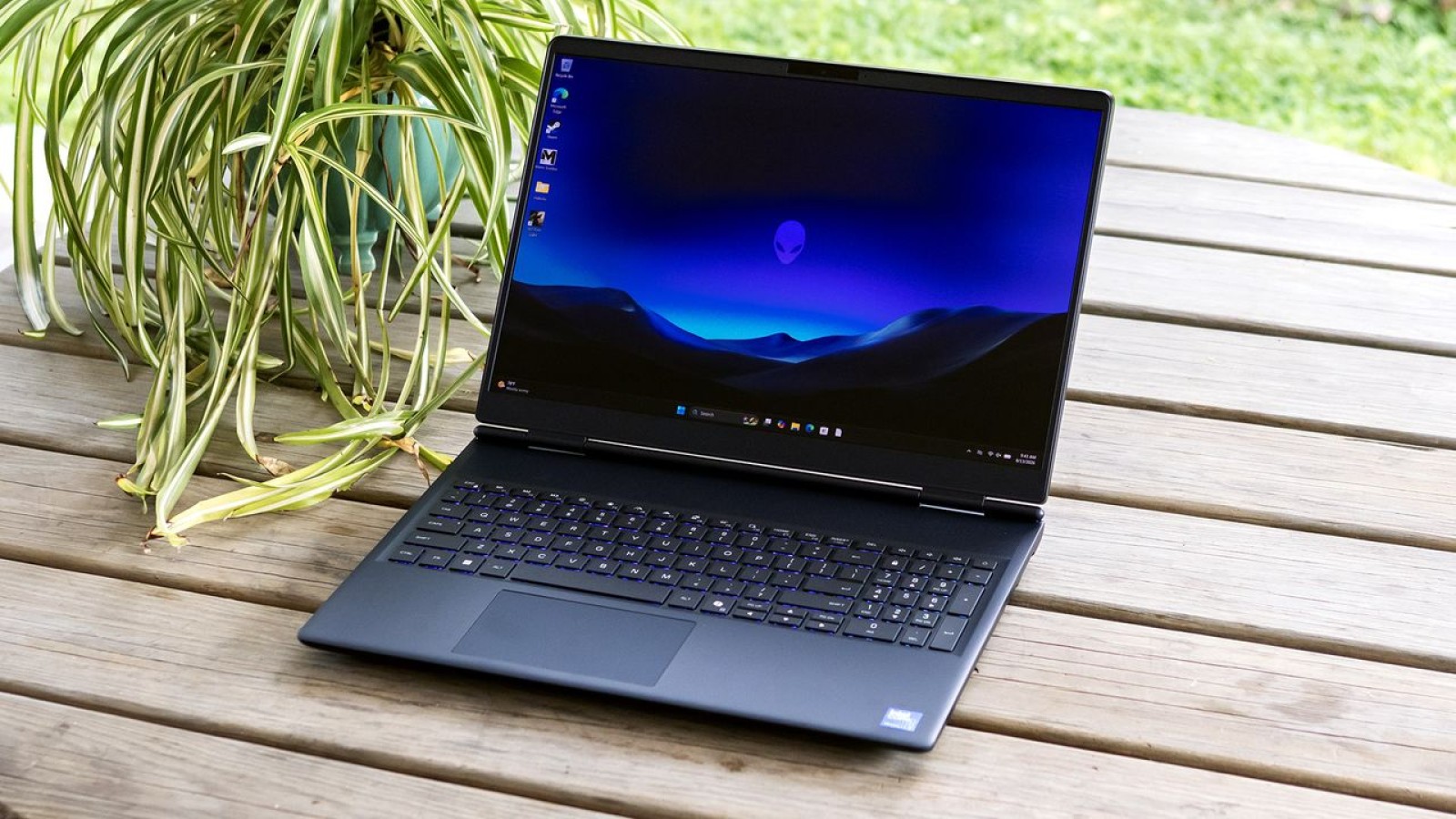
The Alienware 16X Aurora arrives with a starting price of EUR 1,707 and a design philosophy centered on restraint rather than flash. Alienware has embraced a performance-first, minimalist approach here, ditching the RGB lighting for a cleaner chassis while packing in serious internals. Buyers get a 16-inch OLED panel running at 240 Hz, an Intel Core Ultra HX-series processor, and Nvidia’s newest RTX 50-series graphics. The trade-offs are heft and modest battery life, which limit its appeal as a travel machine, but the overall package is a genuinely competent gaming laptop.
Design and Build Quality
This is a deliberately understated gaming laptop. Beyond its nearly inch-thick profile, the Aurora does little to draw attention to itself. The “interstellar indigo” finish is subdued, and the familiar Alien head on the lid barely stands out against it. Unlike many earlier Alienware models, there is no external lighting at all.
Construction feels solid, with aluminum top and bottom panels and a magnesium internal frame that keeps the system rigid, though the lid still opens with one hand. Rounded edges along the bottom make it easier to carry, but at 5.66 pounds it remains a substantial load. For context, Acer’s Nitro V 16S AI weighs 4.55 pounds and Gigabyte’s Aero X16 comes in at 4.2 pounds.
Connectivity is spread across the left and rear edges. You get Thunderbolt 4, USB-C at 10 Gbps, two USB-A ports at 5 Gbps, HDMI 2.1, Ethernet, and an audio jack. Placing several connections on the rear, including the barrel-style power input, helps free up space for a mouse. Inside, a MediaTek MT7925 card delivers Wi-Fi 7 along with Bluetooth 6.
Specifications and Gaming Performance
The configuration tested arrived as the entry-level build, priced at EUR 1,966 as reviewed. It pairs an Intel Core Ultra 7 270HX Plus processor with an Nvidia GeForce RTX 5060 (8GB GDDR7, 115 W, 1,455 MHz boost clock) and 16GB of dual-channel DDR5-5600 memory. Storage comes from a 1TB PCIe 4.0 SanDisk SN7100S SSD.
The star of the show is the display: a 16-inch, 2560 x 1600 OLED panel running at 240 Hz with Nvidia G-Sync support. A 96 Whr battery and a 180 W barrel-connector adapter round out the hardware, all running on Windows 11 Home. The chassis measures 14.05 x 10.45 x 0.92 inches. A 1080p IR camera handles video and facial sign-in.
In gaming, the system delivered between 60 and 70 frames per second in 007 First Light at 2560 x 1600 with medium settings and DLSS enabled, though without frame generation. The game ran smoothly with no noticeable stutter.
For benchmar
Source
Image: tomshardware.com