

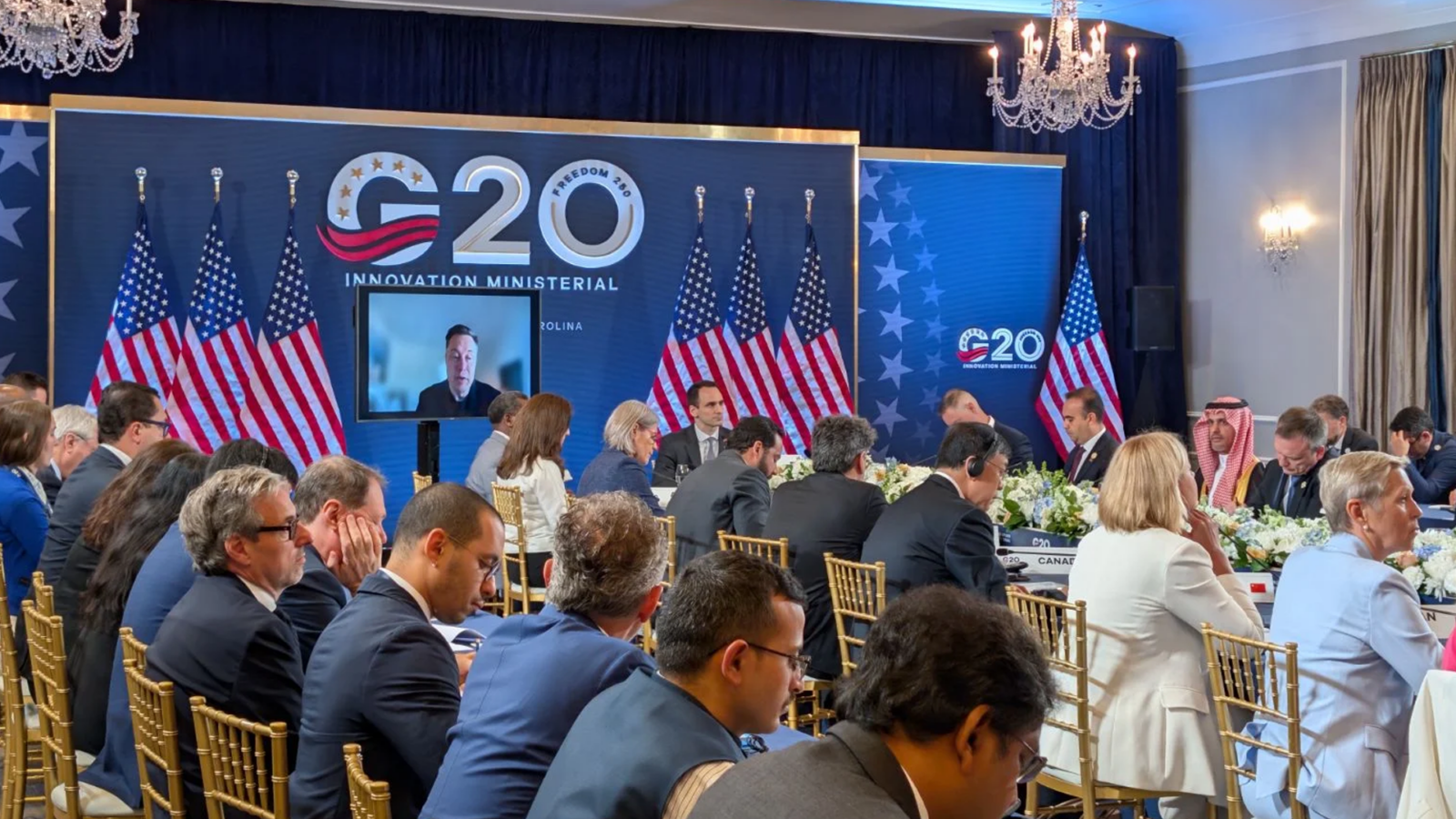
AI regulation took center stage this week as government leaders from the G20 nations convened in Chapel Hill, North Carolina, for the Innovation Ministerial. The message from the US government was direct: nothing should slow the pace of AI innovation, including regulation, power constraints, or safety concerns.
The forum gathered officials from across the G20, including India, China, Russia, and numerous European countries, to examine technological progress and the policy challenges that follow. This year’s central theme is generative AI. Michael Kratsios, director of the Trump administration’s Office of Science and Technology Policy, used his opening remarks to warn that “slow policy adaptation makes it harder to capture the full benefits of innovation.”
Kratsios argued that outdated rules create problems for developers and policymakers alike. “Often, in the US and elsewhere, regulations built for a different technological era prove poor fits for rapidly evolving, generally applicable inventions, creating uncertainty for developers and policymakers alike,” he said, adding that such friction leaves “development efforts abandoned, growth unrealized and nations falling behind.”
The Carolina Principles Framework
At the summit, the US is promoting a proposal it calls the Carolina Principles, described as a pro-innovation framework. The plan aims to strengthen AI research, build pathways toward commercialization, and establish industry-led standards for emerging technologies. Leading figures from the AI sector are scheduled to speak with officials throughout the discussions.
Any policy agreements reached this week will feed into the broader accord that the global community is expected to sign at the G20 Leaders Summit, set to take place in Miami this December. The debate carries growing weight as AI models become more capable and autonomous, offering a window into where the international community may set boundaries for major technology firms.
No ‘DMV for AI,’ Says Former AI Czar
David Sacks, the Trump administration’s former AI czar and co-chair of the president’s council on science and technology, pushed back sharply against the idea of a dedicated regulator. He said it would be a “disaster” for the US to adopt anything resembling an “FDA for AI.”
“Any regulatory agency that has to approve AI product releases will become like a DMV for AI, where new models get stuck in a long queue waiting for approval,” Sacks said during a virtual appearance on Tuesday. He described AI as “just too dynamic and fast-moving for that type of approach,” warning that the US should not “hamstring our innovation that way.”
Sacks rejected the concept of an agency modeled on how the Food and Drug Administration authorizes medicines or how the Federal Aviation Administration oversees airlines. His comments appeared aimed at Anthropic, the only major AI company absent from the event. Its CEO, Dario Amodei, recently advocated for a government review process in an essay, writing that “frontier AI models, like airplanes, should be required to go through technical testing and auditing, and their release should be blocked or reversed as a threat to public safety if they do not meet high standards of safety.”