
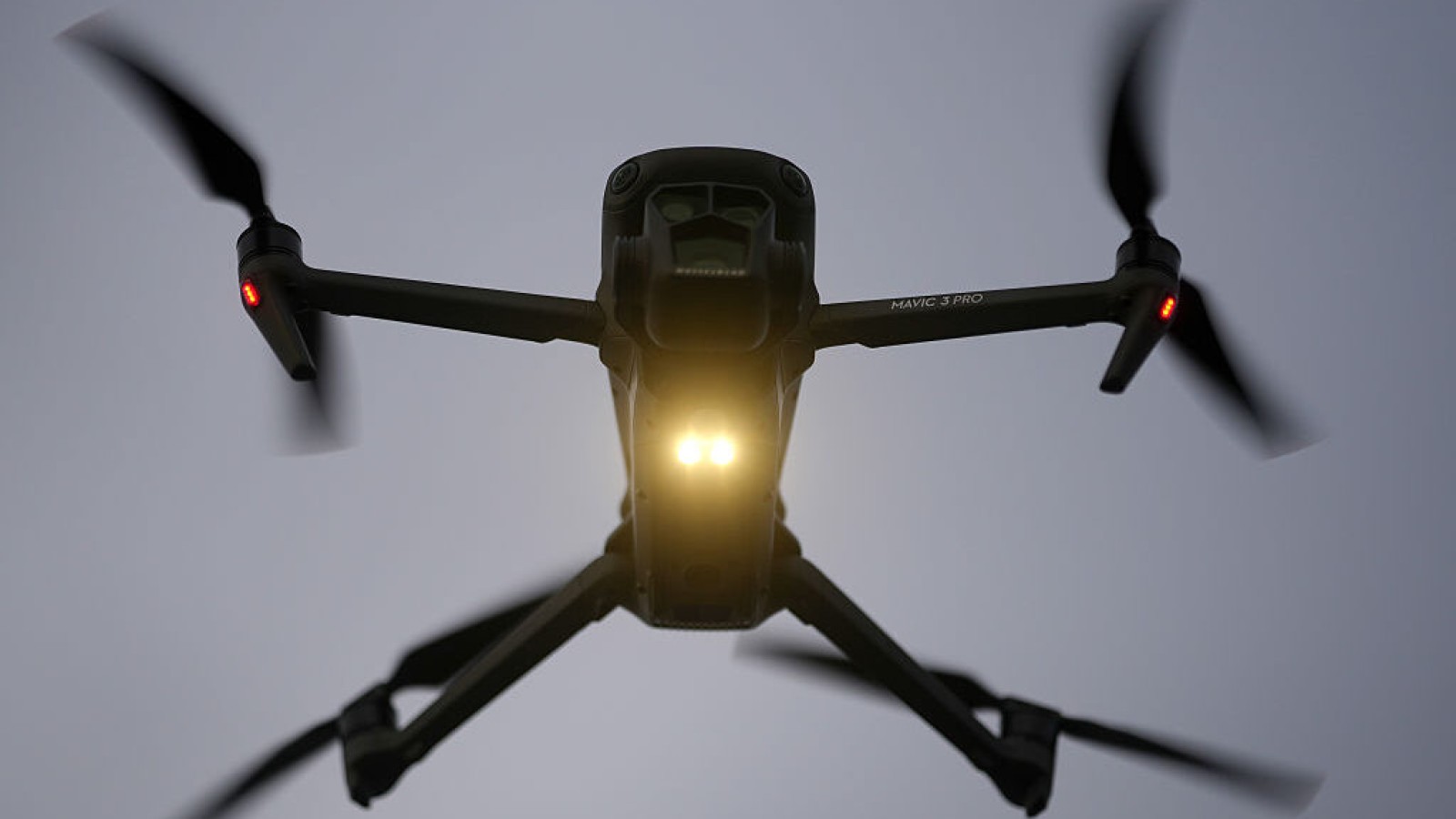
The Trump administration has imposed a 100 percent tariff on foreign-made drones, a move that critics warn could jeopardize public safety operations and hurt thousands of American businesses that depend on the technology. The measure took effect Thursday, according to guidance posted by US Customs and Border Protection.
Under the new rules, the full 100 percent tariff applies to imported drones equipped with thermal imaging or weighing more than 55 pounds. Smaller drones face a 25 percent tariff, while devices manufactured by US allies were hit with lower rates. British-made drones now carry a 10 percent levy, and a 15 percent levy applies to drones from the European Union, Japan, Liechtenstein, South Korea, Switzerland, and Taiwan. Beginning February 9, 2027, “nonsensitive” drones without thermal imaging, along with their components, will be subject to a 25 percent tariff.
President Donald Trump said taxing foreign-made drones would bolster US national security by reducing dependence on Chinese hardware and encouraging the growth of domestic manufacturing.
Why public safety officials are worried
Opponents argue the strategy is short-sighted. A single Chinese firm, Shenzhen-based DJI, manufactures more than 70 percent of the world’s commercial drones, making immediate replacement difficult. Thermal drones are widely considered essential tools for US law enforcement and emergency responders. They are routinely deployed to locate missing people, track spreading wildfires, and support police and rescue operations in environments with unknown risks.
Scott Mlakar, who leads a large unit of police officers and firefighters in the Cleveland area, warned that the tariffs would drive drone costs up so sharply that they would likely put thermal drones out of reach for the communities that need them most.
FCC weighs a broader restriction
The cost increase may not be the only obstacle. The Federal Communications Commission is weighing whether to reclassify a range of common drone technologies as “military grade.” Many commenters cautioned that such a move would further limit access to drones that serve no military purpose and pose no threat to national security.
Industry experts described the potential reclassification as a retroactive ban on drones used by thousands of American businesses and public safety officials. Aerial photographer Vic Moss called the proposal an “industry-killing ban.”
David Hood, an official who coordinates a city’s drone program, urged the FCC to reconsider its plan to categorize any drone equipped with Light Detection and Ranging (LiDAR) sensors as military-grade. “LiDAR is a safety and navigation technology, not a military capability,” Hood wrote, noting that his city relies on LiDAR-equipped aircraft to help avoid crashes. He described the civilian application, collision avoidance, as a safety function rather than a combat function, and recommended that the FCC remove LiDAR-equipped drones from the list of proposed new military-grade categories.
Source
Image: arstechnica.com