

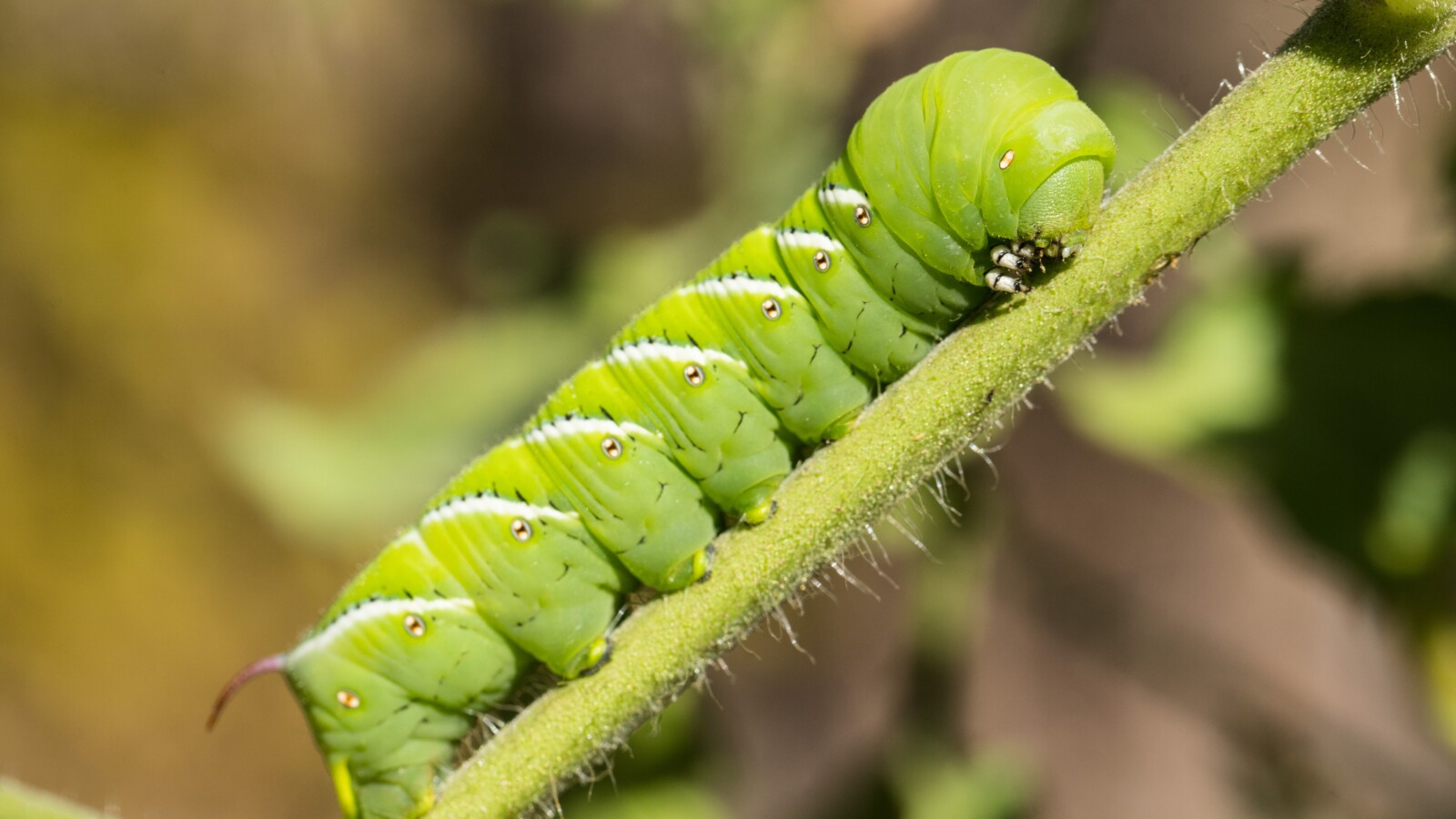
Researchers studying tobacco hornworm caterpillars have uncovered evidence that these earless insects can hear approaching predators, a discovery that could eventually influence the design of cheaper microphone technology. The caterpillars, which have no visible ears, are still able to sense threats such as wasps closing in. A team of biologists and engineers set out to explain how that detection works.
Their ongoing research points to an unexpected mechanism: tobacco hornworms appear to hear using tiny, highly sensitive hairs distributed across their bodies. Because those hairs respond to the faintest stimuli, the scientists needed an environment free of any interfering noise to test them accurately.
Testing Hearing Inside an Anechoic Chamber
To isolate the caterpillars from outside interference, the team turned to an anechoic chamber, among the quietest spaces engineered anywhere. These chambers are built to block unwanted sound entirely. The “floating” structure rests on heavy-duty steel springs that keep it from touching the ground, isolating the space from external vibrations and noise.
Inside the chamber, the researchers spent a full year running daily tests. Each day they placed a single caterpillar on a platform and directed vibrations at it across a range of intensities. To capture the precise movement traveling through the platform, they relied on a device called an accelerometer. The caterpillars responded in different ways, sometimes jumping, sometimes twitching, and at times shuddering from the physical force.
Through repeated observation, the team identified a specific threshold at which the caterpillars stopped reacting. Any vibration weaker than that magnitude produced no visible response at all.
Distinguishing Airborne Sound From Vibration
After documenting that consistent pattern, the scientists ran a second round of experiments using airborne sound as the stimulus rather than direct vibration. Their reasoning was straightforward: if the caterpillars proved more sensitive to sound than to vibration, they were likely hearing sound through the air independently of any physical shaking.
The complication is that sound itself causes objects to vibrate. To rule out the possibility that the caterpillars were simply feeling the platform move, the researchers again used the accelerometer, this time to measure how much the platform vibrated in response to the sound. They compared the platform vibrations in two separate scenarios: one driven by airborne sound and one driven by direct vibration alone.
The results were telling. In the sound experiments, the caterpillars kept reacting even when the stimulus fell below their established threshold for direct vibration. That outcome indicated the animals were genuinely hearing the airborne sound rather than only sensing physical movement transmitted through the platform.
The next question centers on locating what functions as the caterpillars’ “ears.” The research draws on the principle that sound can be perceived in more than one way, either through the pressure of the sound wave itself or through the motion it generates. That distinction is guiding the team’s continued search for the sensory structures responsible, with the fine body hairs standing as the leading candidate.