
NASA’s Nancy Grace Roman Space Telescope, a EUR 4 billion observatory built around a 300-megapixel camera that peers through a refurbished spy satellite mirror, lifted off Sunday from Kennedy Space Center in Florida. The mission is designed to investigate the mysterious forces shaping the cosmos and to broaden how astronomers survey the Universe.
The observatory expands on the legacy of NASA’s most famous instruments. Roman delivers a field of view roughly 100 times wider than the Hubble Space Telescope, while complementing the detailed work of the James Webb Space Telescope. It is only the second NASA-led astrophysics mission to launch this century, following Webb in 2021.
In contrast to Webb, which faced years of delays before reaching orbit, Roman arrived at the launch pad nine months ahead of NASA’s commitment to fly it by May 2027. NASA Administrator Jared Isaacman described the mission as delivered ahead of schedule and on budget, calling it the result of more than a decade of work by the NASA workforce and industry partners.
A Falcon Heavy Sends Roman Toward Deep Space
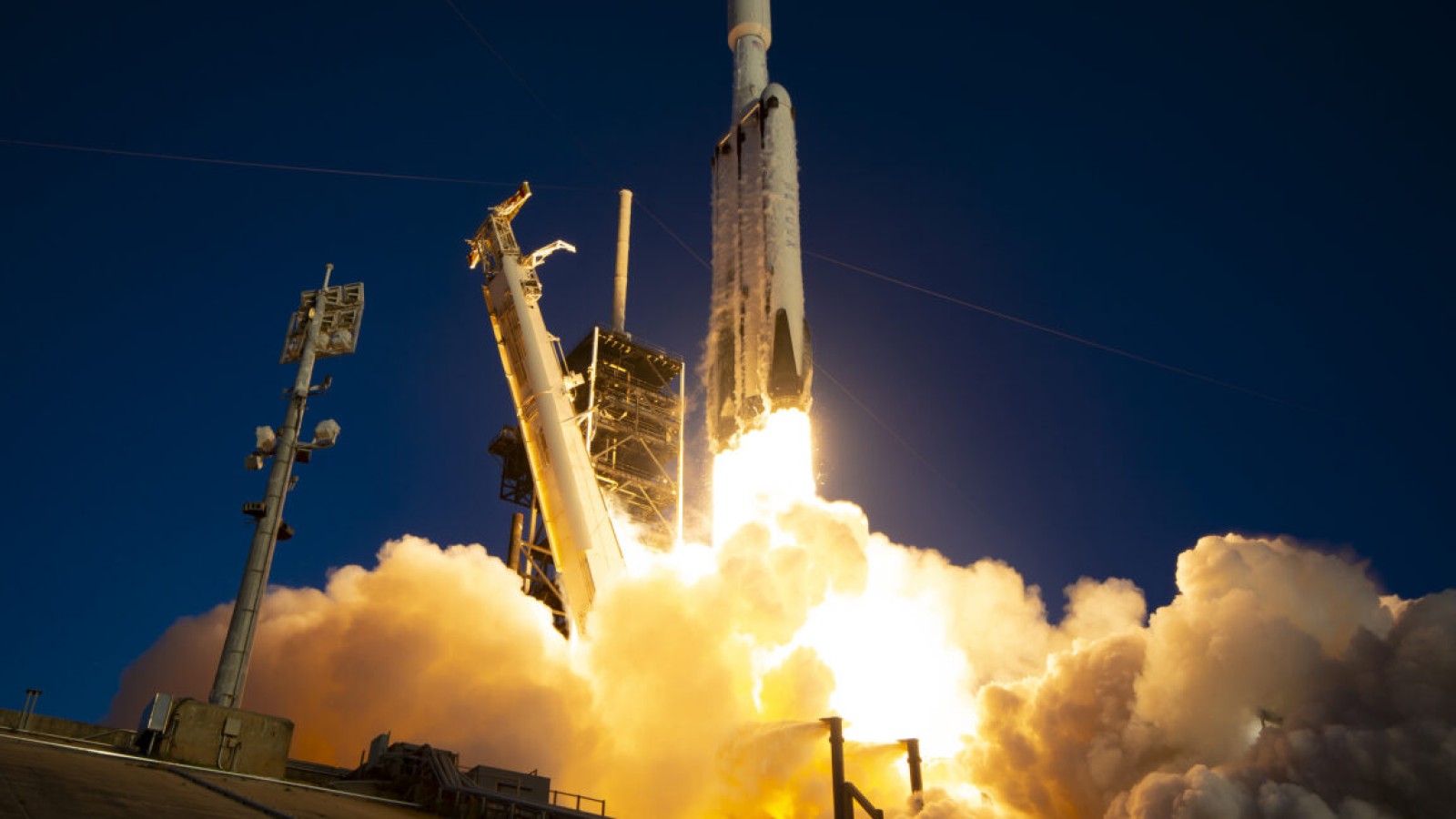
A SpaceX Falcon Heavy rocket, powered by 27 kerosene-fueled main engines, lifted the telescope off Launch Complex 39A at 7:25 am EDT (11:25 UTC) on Sunday. Climbing just after dawn, the rocket flew downrange over the Atlantic Ocean, released its two reusable side boosters for a return to Cape Canaveral, and placed Roman on a trajectory carrying it four times farther from Earth than the Moon.
Fully fueled, the observatory weighed about 20,000 pounds (9 metric tons) and filled the Falcon Heavy’s payload fairing. The rocket aimed it toward the Sun-Earth L2 Lagrange point, a gravitational balance point nearly a million miles (1.5 million kilometers) from Earth. Denton Gibson, NASA’s launch director for the mission, said the spacecraft required all 5 million pounds of thrust from the Falcon Heavy, which performed without issue.
Roman will take about three months to reach its operational orbit around L2. During that transit, ground teams will activate and calibrate the instruments. Scientists aim to publish the first science images by the end of the year.
The Legacy Behind the Telescope’s Name
NASA named the mission for Nancy Grace Roman, the agency’s first chief astronomer and an early champion of space-based telescopes. During her career, she built support within the science community and secured congressional funding for what became Hubble. Roman retired from her NASA leadership role in 1979 and died in 2018.
The observatory was previously known as the Wide Field Infrared Survey Telescope before NASA announced the new name in 2020. With its wide field of view, Roman is expected to produce a new atlas of the Universe, mapping vast regions of space to study the forces driving cosmic expansion. The telescope launched nine months ahead of its May 2027 deadline.
Source
Image: arstechnica.com