

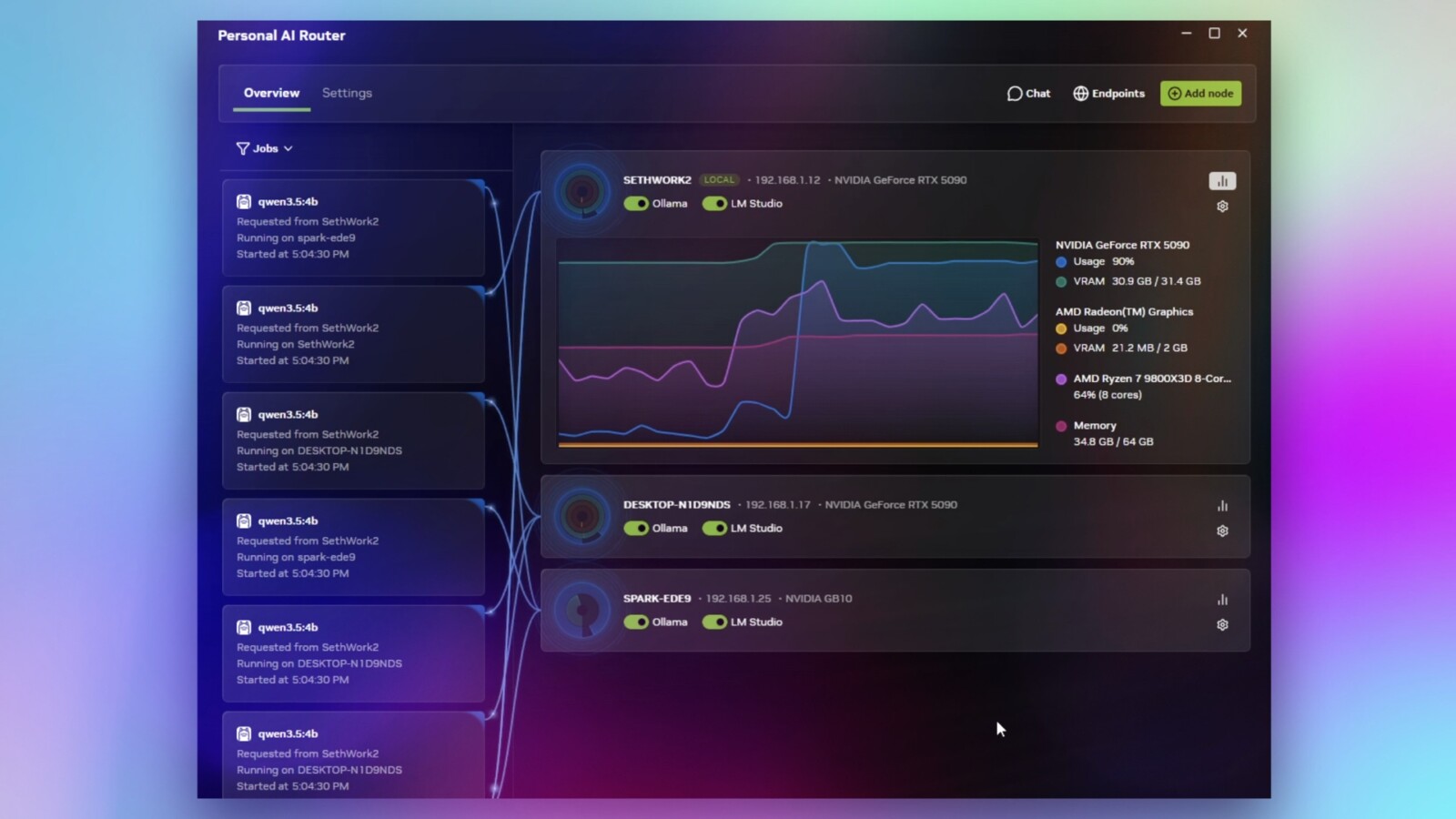
Nvidia PAIR, short for Personal AI Router, is a new system designed to accelerate demanding AI agents by distributing their workloads across multiple computers on your home network. The tool targets users who regularly run complex or GPU-intensive AI agents and want to speed up processing without overloading a single machine. If an agent’s tasks can be split into independent subagents that run in parallel, PAIR offloads that work to other systems on the local network, keeping everything local.
In practice, a primary desktop could run PAIR while a MacBook Pro handles resource-heavy tasks such as classifying and analyzing tens of thousands of photos. The subagents operate on remote machines, freeing the main system for other jobs. PAIR is open-source, entered beta today, and is available on GitHub. It’s built on established standards, including mDNS for discovering devices on the local network and MTLS for security.
How Nvidia PAIR Works
PAIR supports Windows, Mac, and Linux systems. The primary machine appears to require an RTX-class GPU. Nvidia does not list system requirements for Windows or Linux, but Mac systems need an M4-generation processor or later. Because agents run on the remote machines, each system must have the necessary AI models installed and be able to use them. At launch, PAIR is compatible only with the Ollama and LM Studio engines.
After installing the software on each system and connecting them, you run an agent such as Hermes Desktop or OpenClaw on the primary machine. The agent orchestrates the workflow, deciding which subagents to assign, and sends them to PAIR as if it were the engine, acting as a proxy. PAIR then distributes the subagents across the other computers, collects the results, and feeds them back to the agent. The agent determines what needs to run, while PAIR manages where each task runs and handles communication between the agent and its subagents.
What PAIR Does Not Do
PAIR allocates subagents using several criteria, including whether a system is accepting assignments, whether the required inference engine and model are installed, the system’s current workload, and its available GPU bandwidth. Nvidia says it is working to expand and refine these criteria. A dashboard displays real-time status for connected systems.
The software does not solve the harder problem of insufficient resources on individual machines. It does not pool GPU processing or memory, so it cannot run larger models than a single system could normally handle. However, running subagents on separate machines means parallel tasks avoid crowding one memory pool. PAIR also does not break a single subagent across multiple systems; each subagent is assigned to one machine.
For optimal performance, users would likely need to keep multiple systems powered on that they might otherwise leave off. It remains unclear how PAIR behaves if someone streams video or plays a game on a system while it is already running a subagent. PAIR is available now in beta on GitHub.