

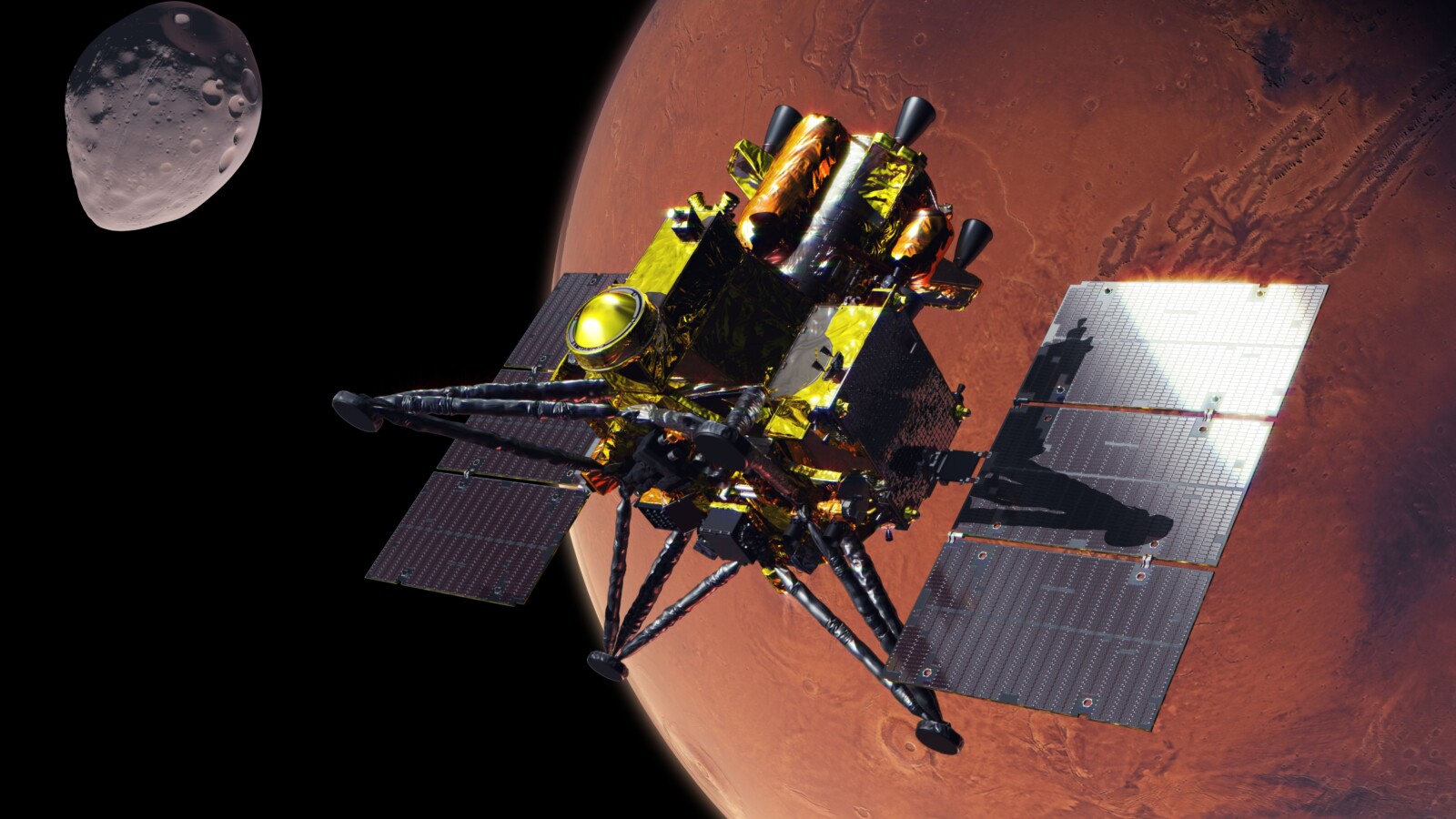
Japan is preparing to launch the MMX (Martian Moons eXploration) probe, a mission designed to gather the first-ever samples from a moon of Mars and bring them back to Earth. The journey will be long: the spacecraft is expected to take roughly one year to reach Mars, spend three years operating in orbit around the red planet while collecting samples, and then require another year to make the return trip. If the mission proceeds as planned, scientists anticipate receiving the moon rocks in 2031.
One of the central scientific goals is to determine how Mars’ two moons, Phobos and Deimos, came to exist. Two leading explanations compete. The first suggests the moons formed from debris thrown off during a massive collision with Mars. The second proposes that the moons were asteroids from the outer solar system that Mars’ gravity later captured.
Evidence currently points in both directions. The moons appear dark, and their light-reflecting characteristics closely match those of asteroids rich in water and carbon, which supports the capture theory. Yet their orbits, which are nearly circular, lie along Mars’ equatorial plane, and follow the same direction as the planet’s rotation, are more consistent with the giant impact hypothesis. Comparing samples from the moons to material previously collected from the Martian surface could help resolve the question.
The Engineering Challenge of Landing on Phobos
Retrieving and returning the rocks requires overcoming major hurdles in spaceflight and communication. At launch, the spacecraft will have a mass of 4,480 kilograms (9,900 pounds), with more than half of that weight consisting of fuel. The propellant is split into three reserves: one for the outbound trip, one for exploration, and one for the return. Near Mars, MMX will discard the outbound module once its fuel is spent, and after a flyby of Deimos, it will also jettison the exploration module.
The probe, built by Mitsubishi Electric, must then land on Phobos, an especially delicate task given the moon’s small size, with a radius of roughly 11 kilometers. By comparison, Earth’s moon has a radius exceeding 1,700 kilometers. Standard lunar descent techniques rely on the moon’s gravity, which is about 300 times stronger than that of Phobos. Phobos, however, has gravity roughly 50 times greater than the asteroid Ryugu, where JAXA has landed probes before. Landing on Ryugu involved extended hovering, a common approach for small bodies, but that method would burn too much fuel at Phobos.
Autonomous Navigation and Signal Delays
To address this, MMX carries high-precision autonomous navigation. That capability is essential because radio signals can take up to 20 minutes to travel between Earth and the probe, meaning MMX must decide on and carry out the descent, landing, and later takeoff on its own.
During descent, the probe will match the terrain against topographic data on Phobos’ craters and adjust toward its target landing site. Below an altitude of 300 meters, it will detect changes in surface elevation, flagging significant discrepancies as hazardous zones. This system allows the probe to shift its landing site or abort and temporarily climb if needed. Shortly before the main spacecraft