
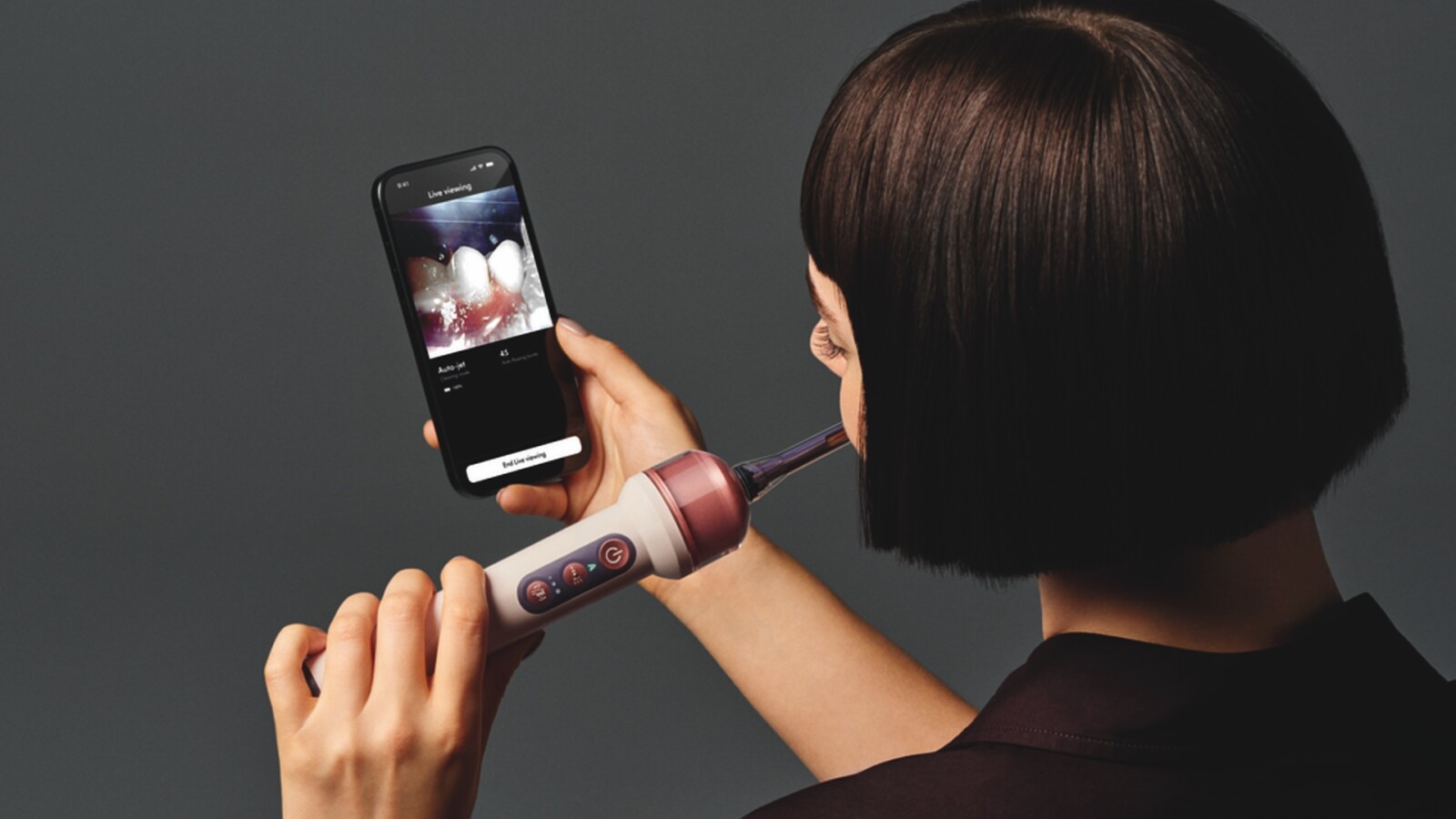
Dyson is entering the dental care market with the CameraJet, a EUR 430 toothbrush that pairs an AI-powered camera with a mouthrinse jet to remove plaque between teeth. The device launched Tuesday and is designed to combine brushing and flossing into a single step.
The concept centers on the gaps where plaque tends to build up. “Our research has shown that people consistently miss the areas where plaque forms: the gaps between teeth,” said founder and chief engineer James Dyson in a press release. “We wanted to solve three fundamental problems: how to see those gaps, remove plaque and how to improve cleaning performance while brushing.” The product was developed over six years by 661 Dyson engineers and 30 dental professionals.
How the Camera and AI Work
The toothbrush’s camera uses a 100,000-pixel macro lens paired with a light. It runs on Dyson’s proprietary machine-learning algorithm, called Gap Optical Targeting, which was trained on 470,000 dental images gathered during development. The system analyzes 28 live images per second and detects gaps between teeth within 100 milliseconds. Once a gap is identified, the jet fires a burst of mouthrinse to clean it.
The CameraJet connects over 2.4-GHz Wi-Fi and Bluetooth, letting users view a live feed through the brush’s live-viewing or auto-jetting modes. The companion app offers coverage maps, guided cleaning, and brushing and flossing feedback. Dyson states that no images are recorded or stored on the device or in the cloud, and that all images remain private to the user.
A Different Approach to Flossing
Working with the National University of Singapore’s Faculty of Dentistry for more than five years, Dyson developed its own proxy plaque to test the flossing jet. Researchers found that traditional water flossers use a needle-like jet that punctures plaque without fully removing it. The CameraJet instead uses a conical jet that covers a wider area at lower pressure, keeping it gentle.
The device holds mouthrinse in a built-in 12.5-ml tank that delivers fluid in any orientation. Dyson describes this as an anti-gravity tank, designed to reduce air pockets that could stop the jet from firing, particularly when the brush is held horizontally to clean the back of the teeth. That design contrasts with what Dyson calls the “straw in a cup” approach used by other water flossers.
Brush Head Details
Each dual-bristle brush head includes an RFID tag that lets the CameraJet recognize when a head is attached and track how many times it has been used, signaling when a replacement is needed. Every head is built with a sonic dampener to reduce noise. To keep the bristles moving and prevent stalling, the CameraJet uses variable sonic oscillation, which adjusts the oscillation angle during use.
The Dyson CameraJet is available now for EUR 430.