
The Nvidia GeForce RTX 5090 has become infamous for one recurring problem: its 16-pin power connector, which has been widely blamed for overheating and, in some cases, melting. Since the launch of the RTX 5090 and the RTX 4090 before it, complaints about burned connectors have circulated throughout the enthusiast community. One group of modders decided to sidestep the issue entirely by removing the connector from the equation and wiring power directly to the card.
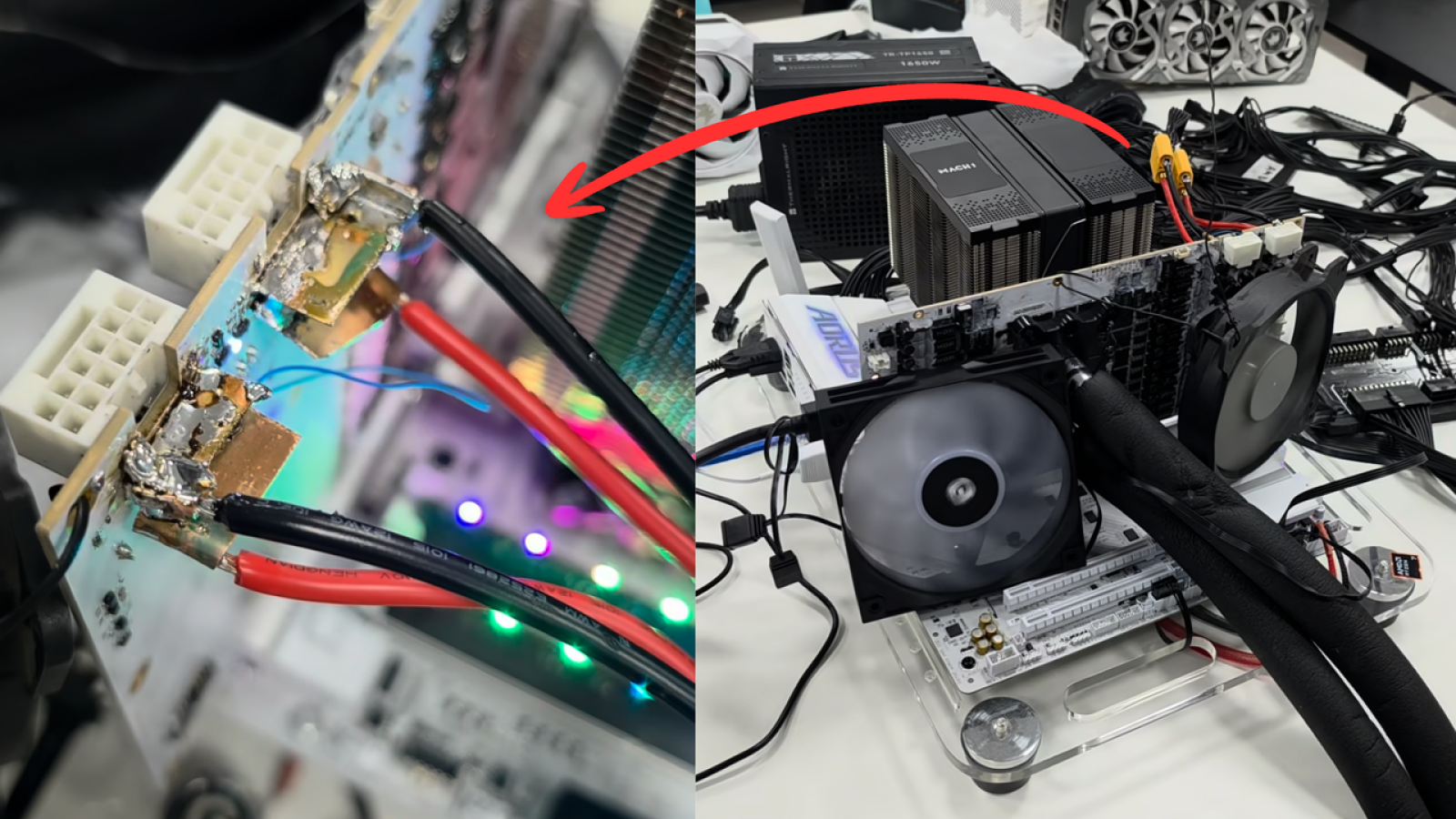
Brazilian YouTuber TecLab carried out the experiment, stripping down an RTX 5090 and feeding it power through cables soldered straight onto the printed circuit board. The card chosen for the test was a high-end Galax HOF OC LAB XOC variant of the RTX 5090D. Unlike standard models that ship with a single 16-pin connector for their 575W TDP, this version carries two power connectors and supports overclocking BIOSes rated up to 2,000W.
How the Direct-Solder Mod Was Done
The modders soldered two sets of wires directly above each power connector on the PCB, connecting them to the connectors’ traces. To make the process manageable, they used two adapters to intercept standard 16-pin cables coming from the power supply and convert them into bare wires suitable for soldering. Despite a rough soldering job, the setup functioned.
To keep temperatures under control, the team removed the heatsink and fans entirely and cooled the core with liquid. Two 120mm fans were loosely zip-tied to the board, while an industrial liquid chiller pushed ice-cold water across the GPU core. No temperature readings were shared, but the card was drawing roughly 600W, based on an approximate 50A measurement from a power meter clamped to the 12V rail.
The Card Booted and Ran Benchmarks
Even without a conventional cooler, the modified RTX 5090 booted normally and posted respectable benchmark results. TecLab framed the project as a tongue-in-cheek response to ongoing complaints about the 16-pin connector, presenting the direct-solder method as their own take on how to handle the issue. The team also emphasized that the approach is unsafe and should not be attempted at home.
The broader takeaway is striking. A hastily soldered connection on a card capable of pulling significant wattage proved to be a workable alternative to Nvidia’s factory power delivery design. The persistence of the 16-pin connector problem has spawned a range of external monitoring tools built specifically to protect these cards, including devices like the WireView. For buyers spending around EUR 4,294 on a flagship GPU, such add-on safeguards represent a small additional cost.
Source
Image: tomshardware.com