
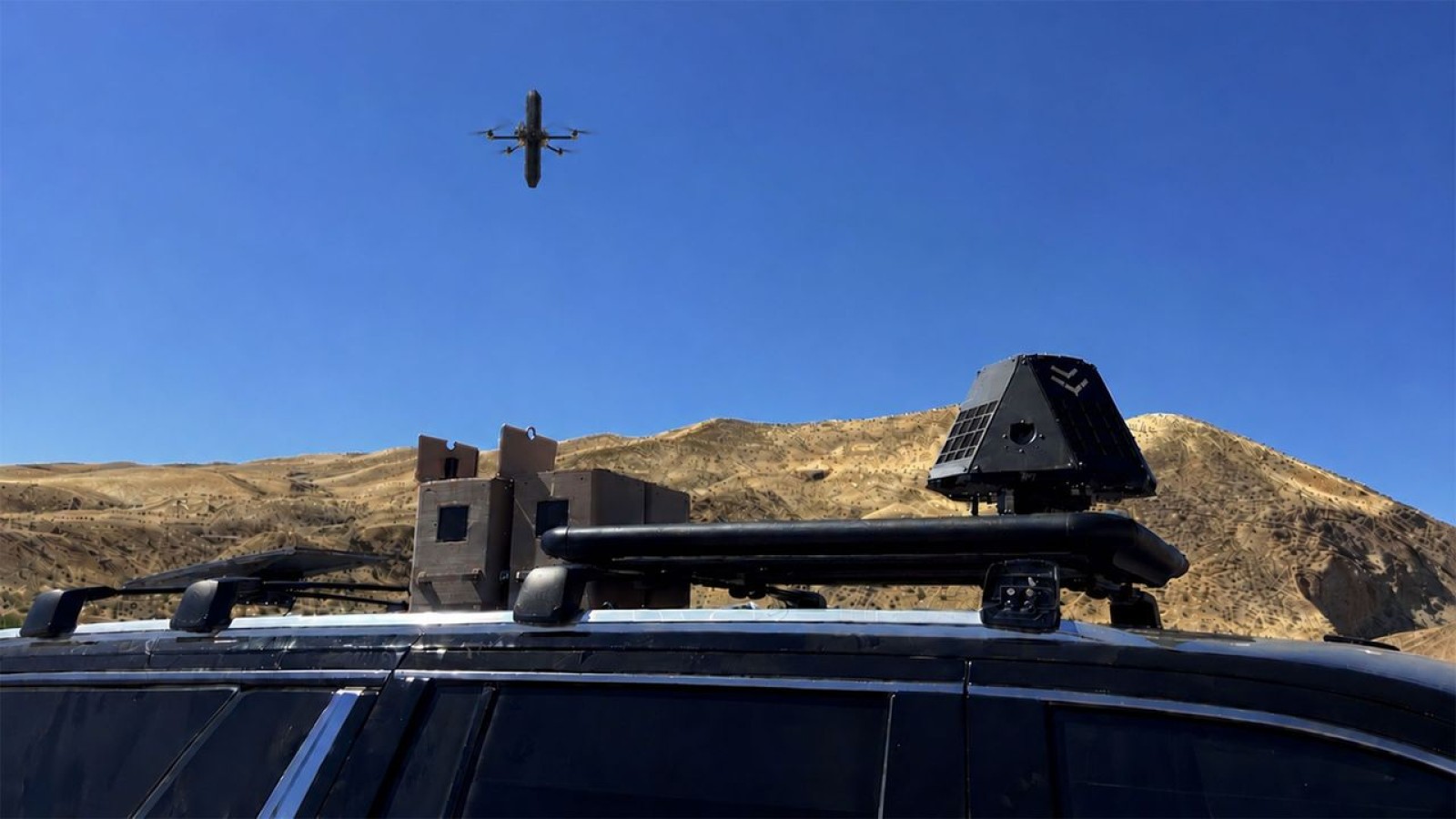
Mara, a San Francisco defense startup, has closed a EUR 6 million pre-seed funding round to build a portable counter-drone system it calls Spike. Designed to fit inside a backpack, the complete system carries a price tag of EUR 25,767 to EUR 85,889, depending on how many interceptors it holds. Its individual autonomous interceptors, dubbed Seekers, weigh just 250 grams (about 8.8 ounces) and are engineered to cost no more than the few-hundred-dollar FPV quadcopters they are meant to destroy.
Those small first-person-view drones carry munitions capable of knocking out armored vehicles worth millions of dollars. They are now reported to be the leading cause of combat casualties among Ukrainian forces, making low-cost defenses a growing priority for militaries.
How the Spike System Works
A single Spike launcher holds up to 48 Seeker interceptors and reloads in under a minute, according to Mara’s published specifications. Each Seeker can engage targets out to roughly one mile. The company says the interceptors are fully autonomous, reacting faster than a human could respond to a quadcopter traveling at 100 mph, though an operator remains in the loop at all times to set rules of engagement and abort launches.
CEO Daniel Kofman described how FPV crews operate along the front line. “They launch from anywhere at anything, and they never attack one at a time. They always attack four to six at a time in waves, doing pincer strikes in rapid succession or simultaneously.”
The targeting component, called Spotter, combines electro-optical and acoustic sensors with an optional low-emission W-band radar. Mara says it can detect and track fiber-optic and fully autonomous drones in any weather, day or night. Those drone types defeat radio-frequency jammers and RF-based detectors because neither emits a control signal that can be located or disrupted.
Cost Advantage and Market Position
Kofman says the Seekers are built to trade at a “one-to-one” or, in a “worst case, two-to-one” cost ratio against the drones they intercept. Mara claims the interceptor costs 20 times less than the next-cheapest alternative. That places it well below reusable systems such as Lockheed Martin’s Morfius X-Rotor, which uses high-power microwaves to down swarms, and near the roughly EUR 8,591D-printed interceptors Ukraine produces against Shahed-type drones. Those Ukrainian units, however, target larger and slower threats than fast FPV quadcopters.
Deployment and Timeline
Mara has joined NATO’s DIANA accelerator 2026 cohort and holds cooperative research agreements with three unnamed U.S. defense organizations. The company is also conducting a civilian pilot at a commercial port in South Korea. Ukrainian forces have operated the Spotter unit near the front line, where Mara says it tracked multiple FPV drones from 40 kilometers (about 25 miles) away. The company has also secured its first paid order from a European NATO partner for an undisclosed exercise.
Ground-mounted Spike units are scheduled to reach customers by the end of 2026. Vehicle-mounted
Source
Image: tomshardware.com