
DLSS 5 has officially launched in NBA 2K27, marking the first game to ship with Nvidia’s controversial upscaling technology built in. We ran the game across every RTX 50-series (Blackwell) graphics card to measure how this debut implementation performs and how it stacks up against the community-created mods that have circulated in recent weeks.
The headline question is whether DLSS 5 is worth the attention, given the debate it stirred after Nvidia first revealed it earlier this year. The short answer is yes. This first-party version, tuned directly under the direction of 2K Games’ art directors and artists, delivers a genuinely impressive visual upgrade rather than a cheap filter effect.
How DLSS 5 Changes the Look of NBA 2K27
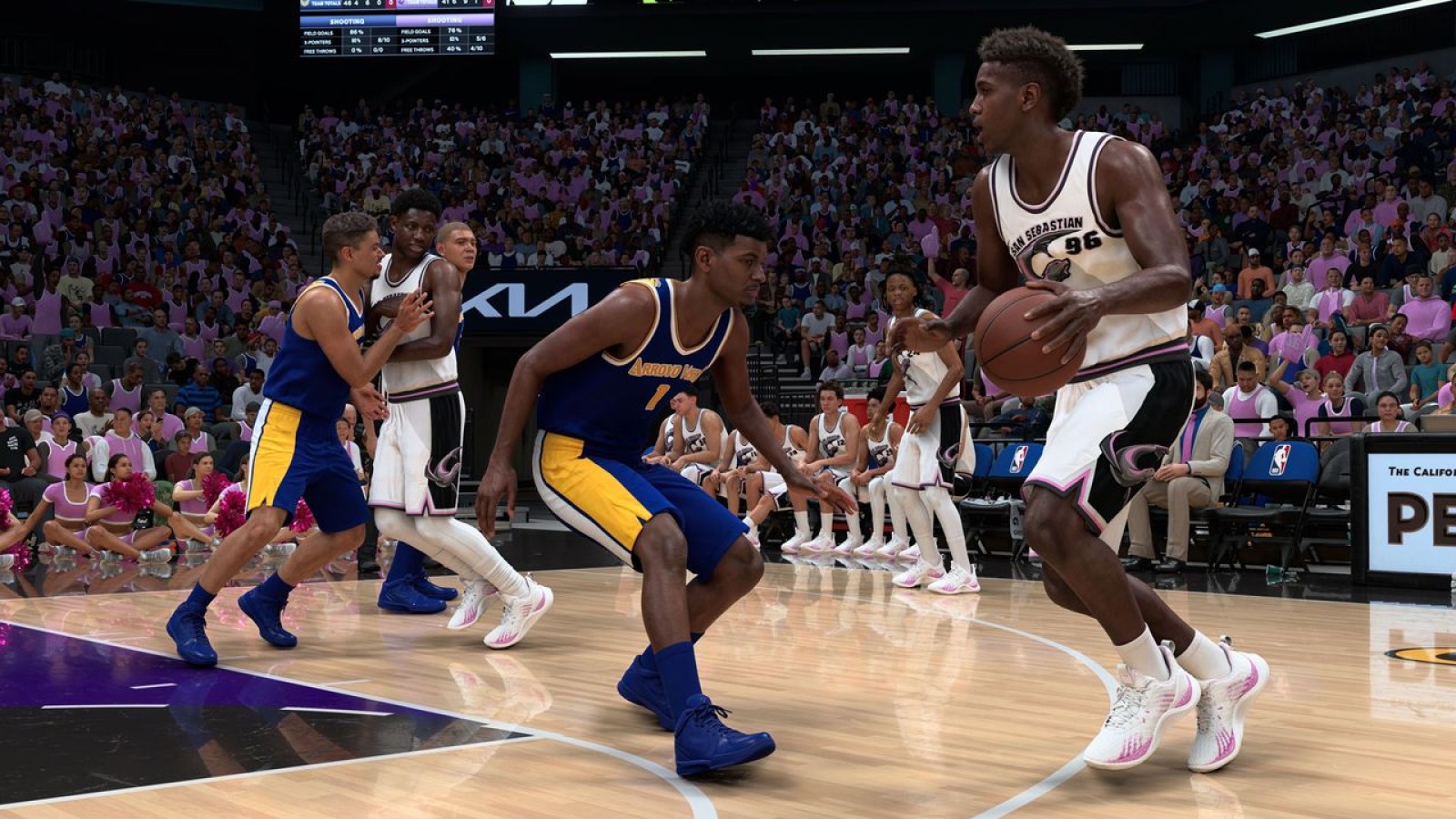
Without DLSS 5 active, even at ultra settings with ray tracing enabled, the game carries a slightly plastic, flat appearance. Faces take on a waxy uniformity that reads as clearly synthetic, hair looks unnaturally flat, and the whites of the eyes can appear too bright, producing a doll-like effect that undercuts immersion. These issues stand out even in a sports title.
With DLSS 5 turned on, the presentation improves substantially. Skin takes on a more realistic, flesh-and-blood quality, eyes render with proper tone, depth, and highlights, and hair looks far more natural. The result makes it easier to suspend disbelief during gameplay. Compared with the mixed results of unofficial DLSS 5 mods dropped into other titles, this official integration shows what the technology can achieve when handled by a studio’s own artists.
Our Testing Methods
Measuring performance in NBA 2K27 is tricky. Benchmarks run in the hub worlds or during cutscenes produce lower numbers than actual on-court play, and in-game events such as fouls and timeouts can skew results if not accounted for. To keep the data clean, we chose a repeatable matchup from the game’s career mode and sampled 60 seconds of continuous gameplay with DLSS 5 both on and off, restarting any run interrupted by scripted events.
We used the game’s maximum graphics settings as our baseline, including ray tracing. All testing was performed at native resolution without upscaling, and we did not enable Multi Frame Generation. We treat MFG as an addition on top of a solid baseline rather than part of the baseline itself.
Test System Configuration
Our 2026 GPU test bench was built with the following components:
CPU: AMD Ryzen 7 9800X3D
CPU Cooler: Thermalright Phantom Spirit 120SE
Memory: 32GB (2x16GB) G.Skill Trident Z5 Neo DDR5-6000 CL30
Motherboard: Asus TUF Gaming X670E-Plus WiFi
Storage: Inland Performance Plus 4TB PCIe 4
Source
Image: tomshardware.com