
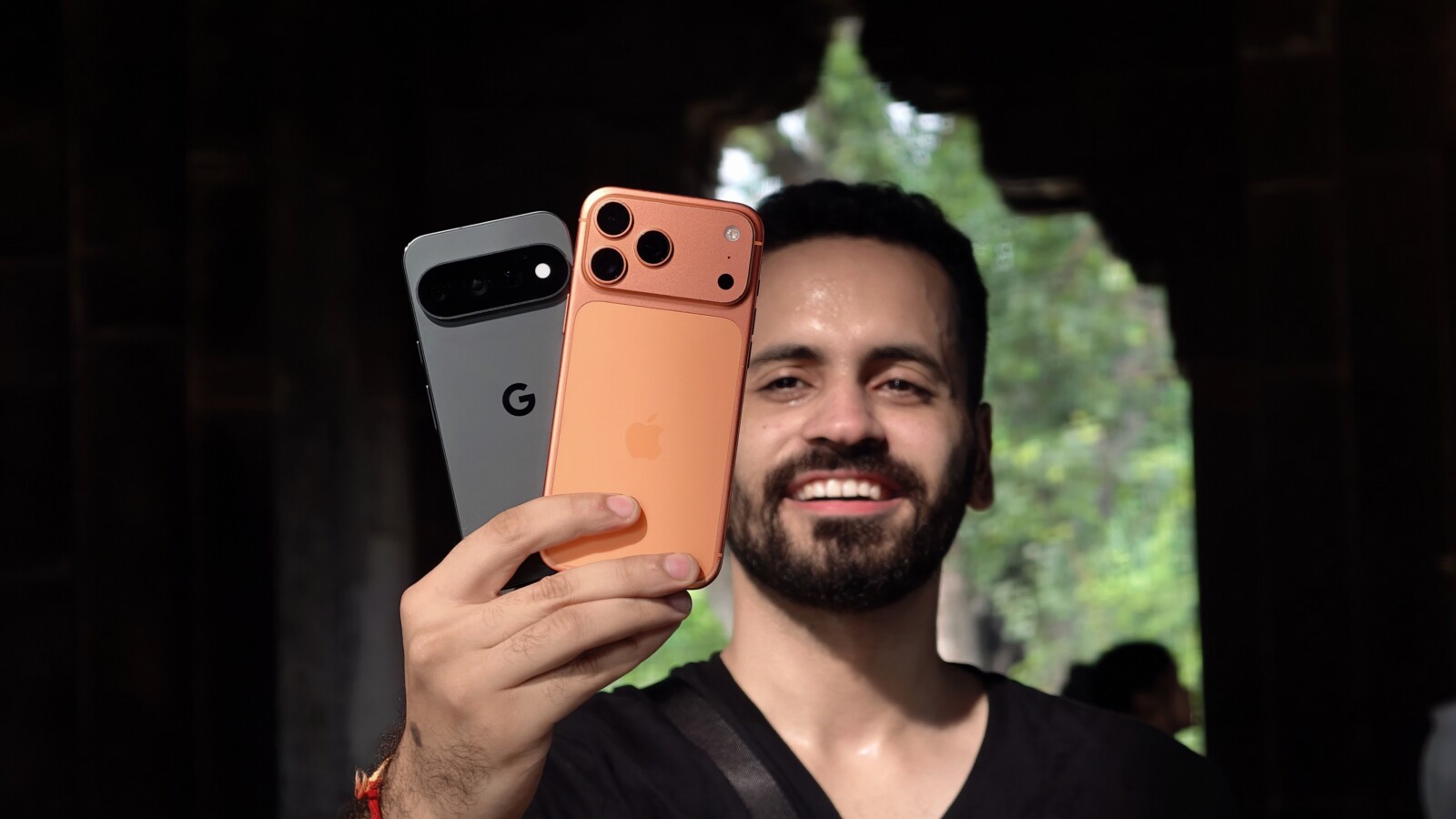
The Google Pixel 11 Pro arrives with a EUR 946 price tag and a promise of significant camera improvements, setting up a natural comparison against Apple’s iPhone 17 Pro. To see how the two stack up in real-world shooting, both phones were carried across various locations in Delhi, including the well-lit courtyards and shadowy corners of the monuments in Lodhi Garden.
On paper, the Pixel 11 Pro’s hardware largely mirrors last year’s 10 Pro. It carries a 50-megapixel wide lens, a 48-megapixel ultrawide and a 48-megapixel telephoto with 5x optical zoom. What’s new are the software and sensor refinements: Google claims better dynamic range on the wide camera and a 30% increase in light sensitivity on the zoom sensor.
The iPhone 17 Pro remains a strong performer despite being a year old. It pairs 48-megapixel wide, ultrawide and telephoto cameras, with the telephoto offering 4x optical zoom that extends to 8x magnification through Apple’s software processing.
Color Science and Detail in Everyday Shots
Both companies offer color profiles that let users apply a personal creative style rather than relying on default output. For this comparison, however, default processing was used across all lenses. The two brands take notably different approaches: Google tends to brighten shadows, while Apple aims for a more natural tone.
Under overcast conditions, the iPhone 17 Pro produced colors that looked more accurate to the actual scene. The Pixel 11 Pro, on the other hand, exposed the overall frame more effectively and delivered wider dynamic range. Looking closely at foliage, the Pixel captured more detail in the shadows, while the iPhone’s version appeared less vibrant by comparison.
Portraits and Sensor Specifications
For portrait photography, both handsets deliver solid results, though neither matches the Ultra models from Vivo, Xiaomi or Oppo sold in international markets. The Pixel 11 Pro introduced a slightly pink hue in its portraits, yet it rendered skin tones that looked more natural, while the iPhone’s portrait came across as overly processed. Notably, Google is now allowing portraits to be captured with the telephoto camera.
The sensor details underline the differences between the two systems. The Pixel 11 Pro’s main camera uses a 50-megapixel, 1/1.3-inch sensor with optical image stabilization at a 25mm equivalent. Its telephoto pairs a 48-megapixel, 1/1.95-inch sensor with 5x optical zoom at 120mm, and its ultrawide offers a 123-degree field of view.
The iPhone 17 Pro counters with a 48-megapixel, 1/1.28-inch main sensor at 24mm and a 48-megapixel telephoto built around a 1/2.55-inch sensor with 4x optical zoom at 100mm. Its ultrawide camera covers a 120-degree field of view. A rumored iPhone 18 Pro is expected to debut on Wednesday.