

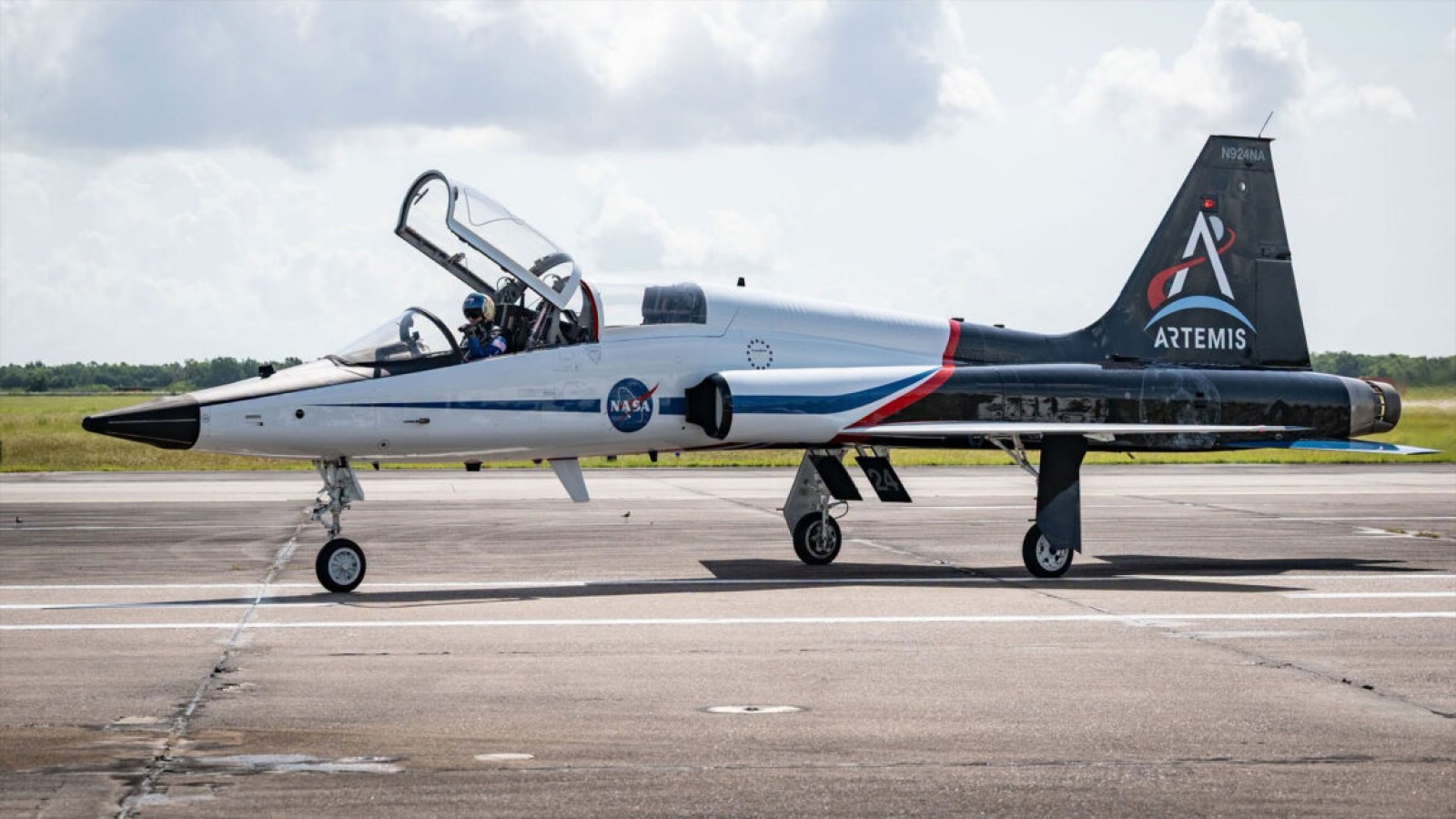
For the first time in decades, NASA has unveiled one of its legendary astronaut training aircraft with a fresh, eye-catching design. The space agency revealed a new livery on one of its T-38 jets to celebrate its ongoing mission to return astronauts to the Moon. The redesign preserves the elements that made the “white rocket” instantly recognizable while adding a new color scheme and painted graphics that signal where the agency is headed.
The updated design carries a black and white paint scheme separated by blue and red stripes, according to Sean Brady, who proposed and created the livery while serving as the T-38 project pilot in NASA’s Aircraft Operations Division (AOD) at Johnson Space Center in Houston. The rear fuselage features the Artemis program logo, along with an image of the Moon painted on both the left and right sides.
A Training Jet With Six Decades of History
The Northrop T-38 “Talon” is a two-seat supersonic trainer that NASA has operated since 1962, when the first jets were loaned to the agency by the US Air Force. Today, the aircraft help familiarize new astronauts with working in high-stress, fast-paced conditions while keeping pilots proficient in flight operations. Johnson Space Center currently maintains a fleet of 14 active T-38 jets stationed at nearby Ellington Airport.
All but one of those aircraft wear the classic blue-stripe livery that has defined most of NASA’s fleet for the past five decades. The Artemis jet, identified by its tail number N924NA (or simply 924), now stands apart. It was selected for the new design because it was next in line for a scheduled repaint as part of AOD’s routine aircraft maintenance.
Crew Reaction and the Road to the Moon
The redesigned jet has quickly become a favorite among pilots. Brady noted that everyone wants to fly the aircraft now because it’s the new “shiny toy,” a joke he’s heard around the office. Artemis III mission specialist Andre Douglas praised the look after sharing a photo of himself and NASA instructor pilot Andre Price posing with the aircraft on social media on August 20, calling the paint job “a nice treat.”
Douglas, along with NASA astronauts Randy Bresnik and Frank Rubio and European Space Agency pilot Luca Parmitano, is targeted to launch on the Artemis III mission no earlier than June 2027. That flight will test rendezvous and docking techniques with prototype lunar landers in Earth orbit.
If Artemis III proceeds as planned, Artemis IV could mark the first crewed lunar landing since the Apollo program, potentially as early as 2028. NASA’s longer-term goals include establishing a base at the lunar south pole to search for and mine water ice, while preparing astronauts for future surface operations on Mars.
Source
Image: arstechnica.com