
For the first time in more than 30 years, NASA has no firm plans to send a new lander or rover to Mars. Instead, the agency’s near-term strategy at the red planet centers on aerial drones, a mode of exploration that seemed unrealistic only a few years ago.
The first genuine use of drones for science at Mars will arrive with the SkyFall mission, a fleet of three helicopters that could launch as soon as late 2028. The SkyFall helicopters will travel to Mars aboard NASA’s Space Reactor-1 “Freedom” mission, whose primary goal is to demonstrate nuclear electric propulsion in deep space.
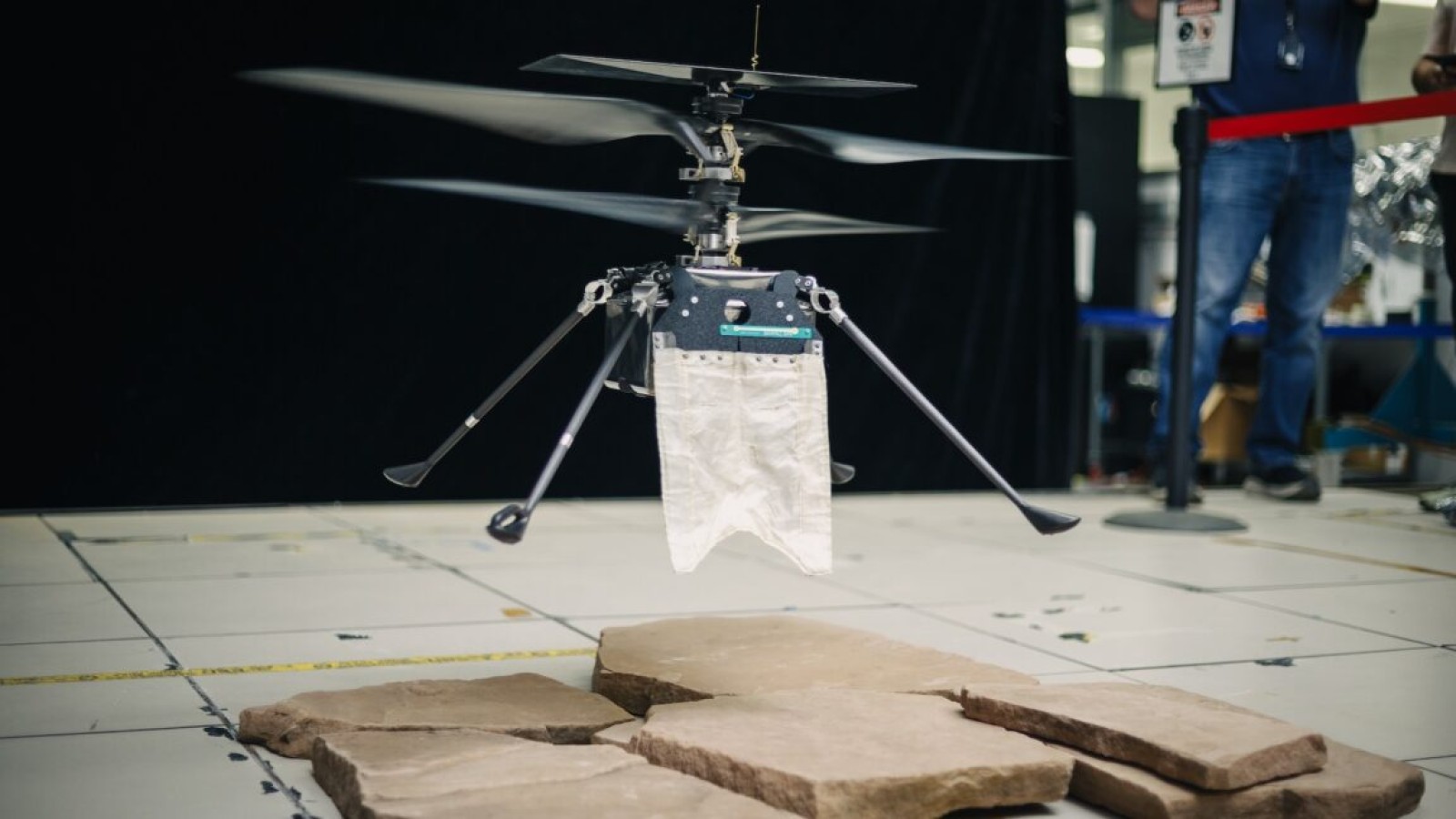
The timeline is aggressive for both SR-1 Freedom and SkyFall, projects that were not part of NASA’s portfolio six months ago. The SR-1 Freedom mission, estimated to cost EUR 2 billion, would repurpose the core module of the canceled Gateway lunar space station into a testbed for nuclear electric propulsion. SkyFall builds on NASA’s success with the Ingenuity helicopter, the experimental vehicle that became the first rotorcraft to fly on another world back in 2021.
Who Is Building the Three SkyFall Helicopters
NASA’s Jet Propulsion Laboratory is teaming with AeroVironment, a developer of high-altitude drones, to design and build the three SkyFall helicopters, plus one spare. The same team produced Ingenuity, which landed on Mars with the Perseverance rover five years ago.
AeroVironment announced last week that it received a contract from JPL to “co-design and co-manufacture” the three helicopters. Ingenuity flew 72 times before a crash landing in early 2024, far surpassing its original plan of five test flights. Engineers are building on that design for SkyFall. The new vehicles will be somewhat larger than Ingenuity, about 2.5 kilograms (5.5 pounds) versus 1.8 kilograms (4 pounds), with upgraded rotors to handle a heavier payload.
SkyFall will show that “Mars helicopters can be built as a repeatable product line, not a one-off delivery,” said Jeff Rodrian, head of AeroVironment’s MacCready Works division, the company’s advanced research and development organization.
New Instruments and Greater Range
AeroVironment is responsible for the helicopters’ rotor systems, airframes, structures, avionics integration, and accommodation for science payloads, according to the company. JPL will develop the power system, electronics, algorithms, and software, along with a ground-penetrating radar to search for shallow subsurface ice beneath the Martian surface. Each helicopter will also carry a suite of cameras and sensors to gather data on the Martian atmosphere.
That marks an upgrade over Ingenuity, which carried two cameras but lacked sophisticated scientific instruments. Ingenuity’s range was limited by a requirement to communicate through a base station on the Perseverance rover. SkyFall, by contrast, will be able to transmit and receive data through communications relay orbiters flying overhead, giving it far greater operational reach.
Source
Image: arstechnica.com