

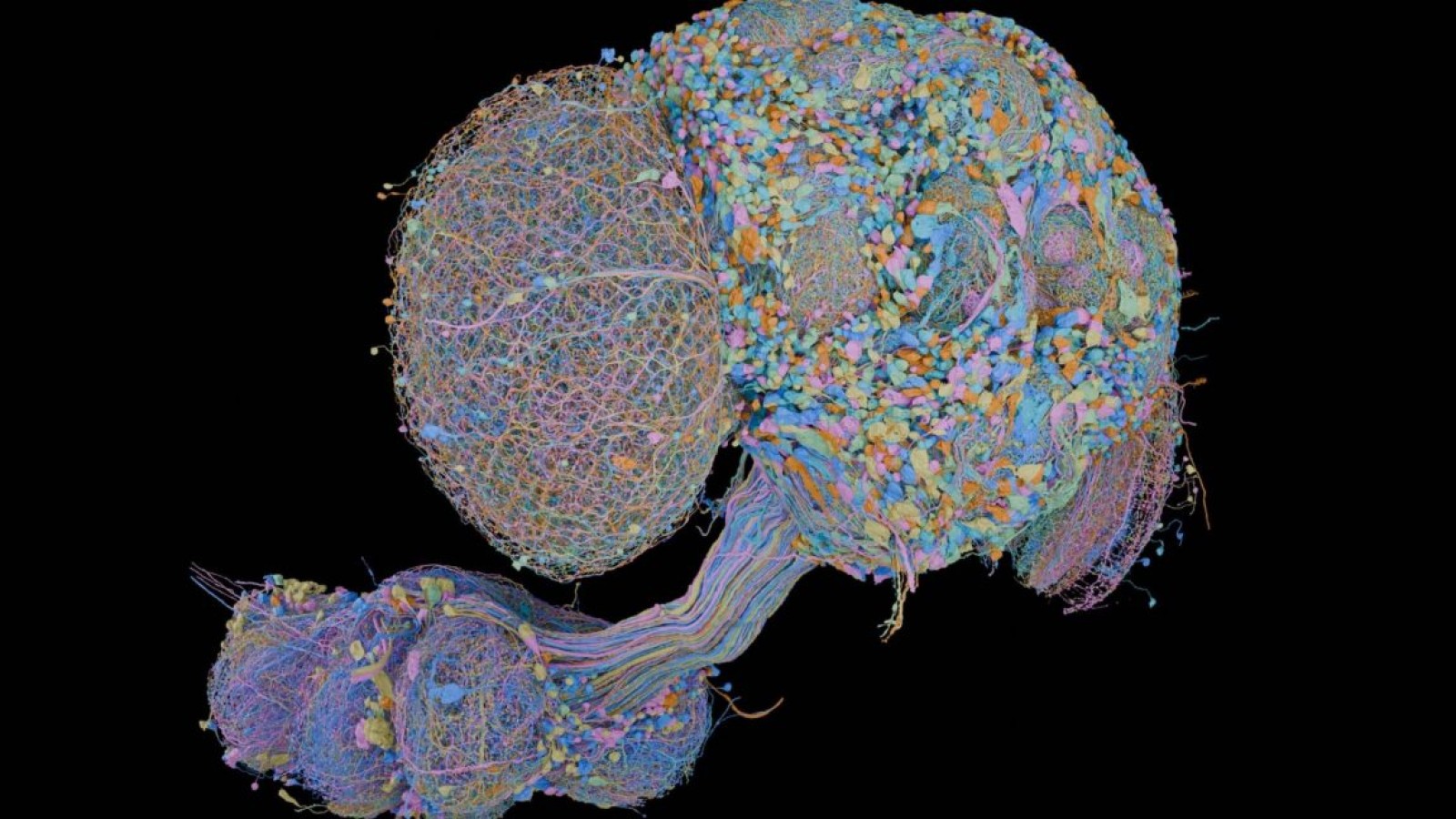
Researchers have completed a connectome of every neuron in the brain of a male fruit fly, adding a second full map of the insect’s nervous system to science’s growing toolkit. The achievement follows the completion of a female Drosophila brain map earlier this year, giving neurobiologists two reference points to compare and study.
The project was a collaboration between biologists at the Howard Hughes Medical Institute’s Janelia Research Campus and computer scientists at Google. Both teams acknowledged that neither group could have completed the work alone. Preparing an entire brain for high-resolution imaging requires specialized biological expertise, while interpreting the resulting data and mapping hundreds of millions of synapses demands computational power far beyond what humans could manage manually in a reasonable timeframe.
What a connectome maps
A connectome is a complete catalog of every neuron in a brain, including its location in three-dimensional space and the connections, called synapses, it forms with other neurons. Brain activity depends heavily on which neurons connect to which. Sensory input from sound, light, and touch enters the system, and neurons then communicate to route and transform those signals into memories, movements, and other outputs.
Mapping those connections is harder than it sounds. Each neuron can form multiple branched extensions known as axons, enabling hundreds of links to other cells. The fruit fly’s nervous system contains roughly 150,000 neurons, with the brain holding only a fraction of that total. Even so, the new map identified more than 300 million synaptic connections in the fly brain.
Refining tools for bigger brains
Beyond serving as a research resource, the project let the team sharpen techniques likely to be applied to increasingly complex nervous systems, potentially including those of vertebrates. The researchers expect the long-term payoff to justify the effort, since a completed connectome offers a valuable framework for understanding how brains process information.
Gerry Rubin, a senior group leader at Janelia Research Campus and a senior author on the paper, described how dramatically the field has evolved. He recalled arriving as a graduate student at the United Kingdom’s Laboratory of Molecular Biology in 1971, where researchers had already invested in a large computer with the intent of applying machine methods to biological questions.
The comparison between male and female fly connectomes also opens a direct avenue for scientific inquiry, allowing researchers to examine how neural wiring differs between the two. Because the visual system performs basic recognition before passing results to processing centers, and those centers route information onward through defined connections, a detailed map lets scientists trace how signals flow through the brain’s various systems.
The male fruit fly connectome was announced on a Friday, joining the female map completed earlier in the same year.
Source
Image: arstechnica.com