
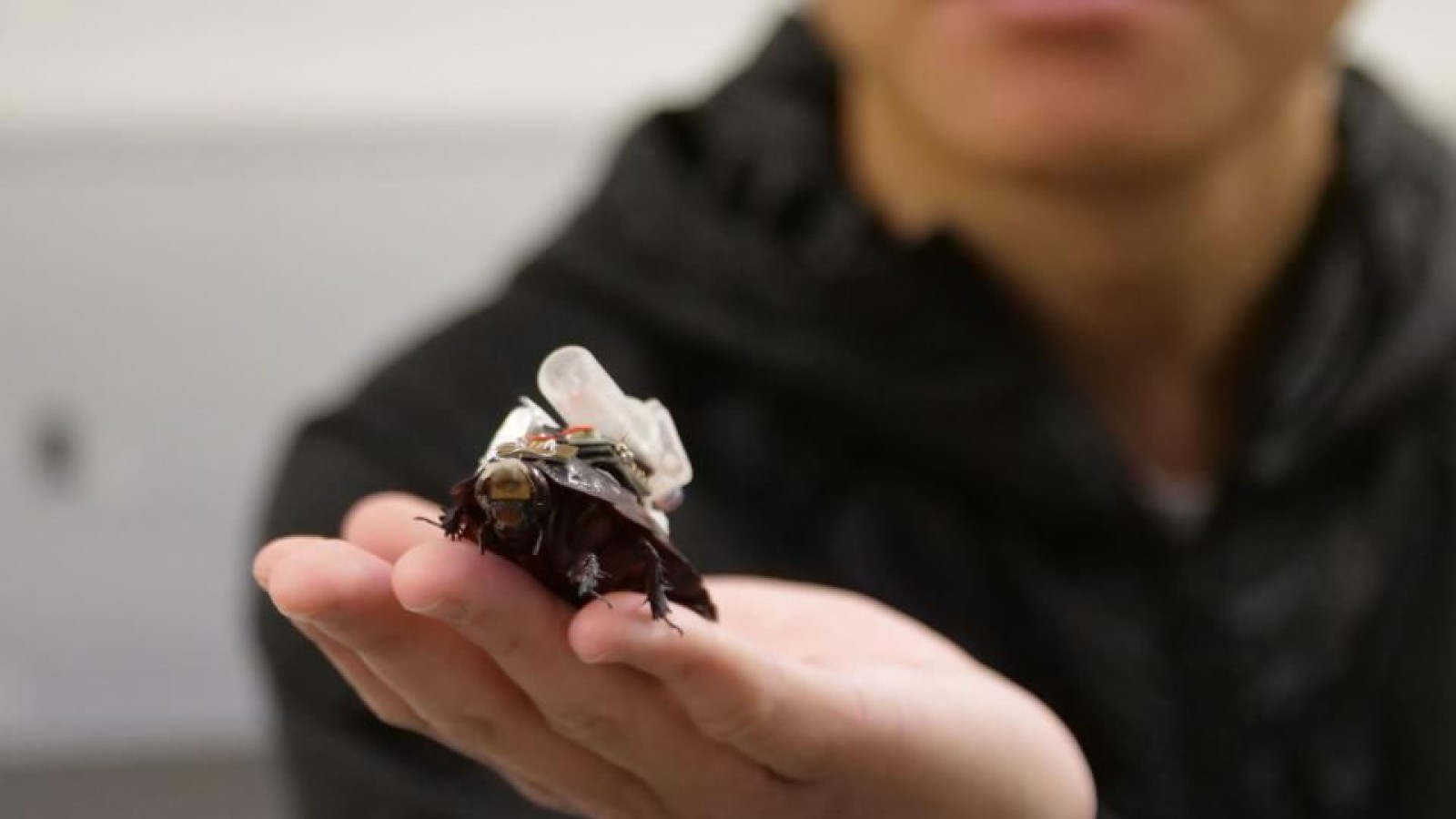
A new class of cyborg cockroaches designed to locate disaster victims and administer emergency medication could one day buy human rescuers valuable time in the field. Researchers from the University of Queensland (UQ) and the University of New South Wales (UNSW) developed the insect-machine hybrid, which they call the Paraborg, and documented their work in a paper published in the journal Advanced Science.
“Cyborg insects have been designed for ‘search and explore’ missions for the past couple of decades,” said Tan Vo Doan, a bio-robotics researcher at UQ. “We wanted to take the next step.”
How the Paraborg Works
The team built the Paraborg using a giant burrowing cockroach native to northern Queensland. The armored insect measures up to 87 millimeters (3.5 inches) long and weighs up to 40 grams (1.4 ounces), and it can carry up to 1.5 times its body weight. That size allowed the researchers to develop two versions: one fitted with a camera to film victims’ conditions, and another equipped with an automatic injection mechanism to deliver medication.
A cockroach carrying the injection device grew about 15 millimeters taller and roughly 17 grams heavier, a load the study found did not significantly impair normal movement. To assemble each cyborg, the team anesthetized the insects while attaching electrodes and microchips. The cockroaches resumed normal behavior once the equipment was removed.
Researchers steered the insects by applying electrical stimuli to electrodes embedded in the antennae and cerci, a pair of sensory organs at the rear of the abdomen. Stimulating each antenna independently controlled direction, while stimulating both cerci controlled walking speed. The team used frequencies between 10 and 40 hertz, having found that anything above 50 hertz became ineffective over time.
Chemical Reaction Powers the Injection
The injection mechanism is a small device that deploys a syringe using a spring system. Triggering it breaks the seal between a chamber of citric acid and one of baking soda. The resulting reaction, similar to the classic baking soda and vinegar experiment, produces enough carbon dioxide to push the syringe plunger and administer the medication.
Test Results and Teamwork
In the study, researchers remotely guided a cockroach from a starting point through three checkpoints to inject a simulated target. Close-range injections, within 150 millimeters of the target, reached a success rate of about 95 percent. The success rate for the entire sequence, from departure to completed injection, was 72 percent.
The team also demonstrated coordination between insects, with one cockroach using a camera to locate a simulated target while another served as the injector. The researchers had previously developed cyborg beetles capable of climbing vertical walls.