
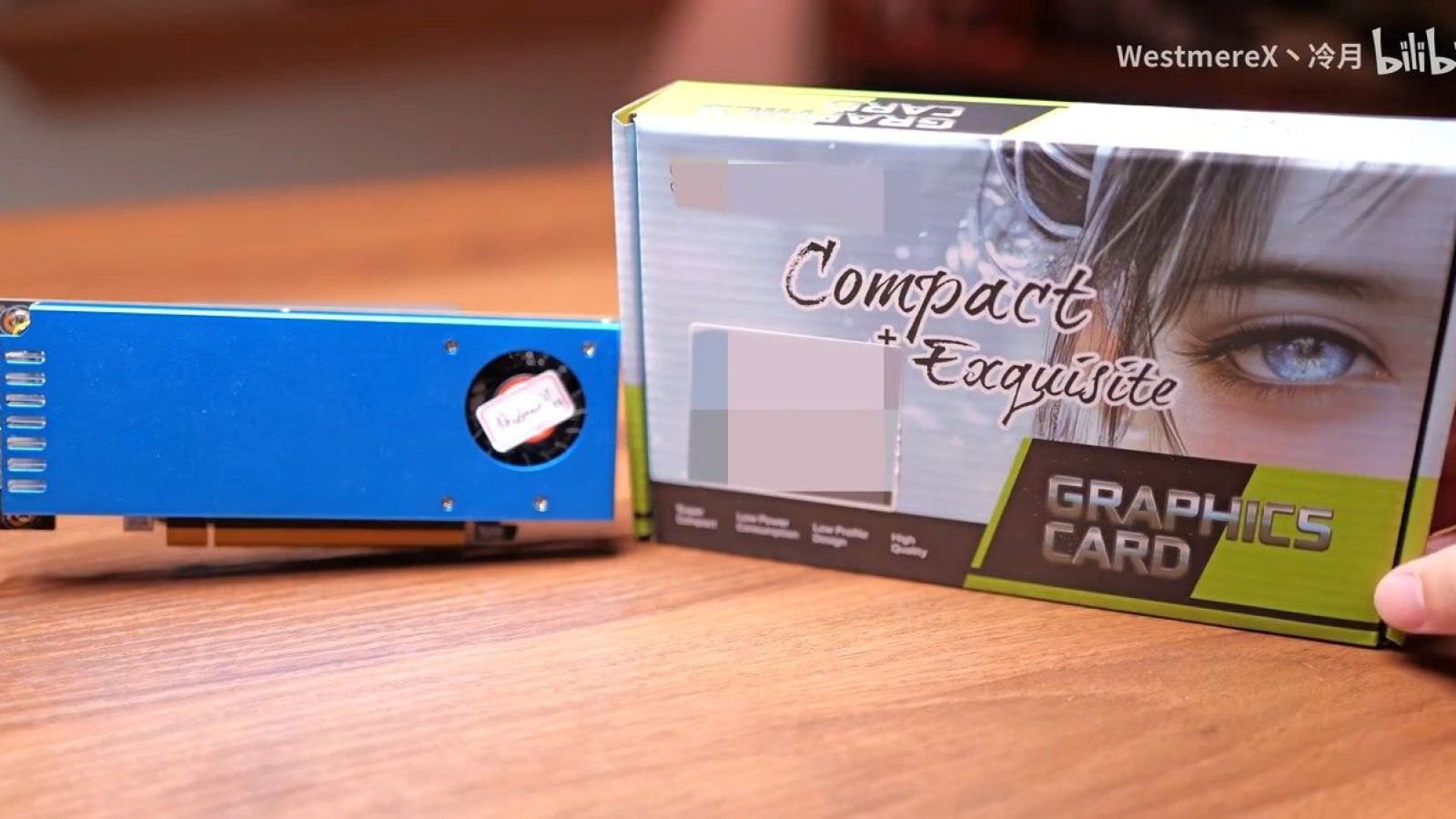
A modified 75W RTX 3060 that ditches external power connectors entirely has surfaced from China, and testing confirms it delivers severely reduced performance alongside troubling thermals. The card draws all of its power from the PCIe slot, which supplies up to 75W, eliminating the need for any 6- or 8-pin cables.
Nvidia originally launched the GeForce RTX 3060 (12GB) in early 2021 as an affordable mainstream gaming GPU rated at a 170W TDP, and reissued it two months ago to ease pressure during the ongoing component shortage. The stock card runs at 170W but can drop as low as 100W through undervaluing with only modest performance loss.
How the Cableless Design Works
Pushing a 3060 down to 75W requires a shunt mod. The technique is usually tied to unlocking power limits for overclocking by lowering resistance, but here the modder did the opposite and increased it to cap consumption at the slot’s ceiling.
The result is a single-slot, low-profile card with a blower-style cooler roughly the size of a modern smartphone. Connectivity is limited to one HDMI and one DisplayPort output. There is no fin stack, the PCB lacks a backplate, and a thin metal sheet handles heat dissipation with only a rudimentary heatsink in the middle.
Skimpy Internals and Thermal Trouble
A teardown revealed the card is under-equipped inside as well. The memory chips carry no thermal pads or paste, and the metal shroud contacts the core directly for cooling. A single fan sits at the far end to expel hot air, with no proper intake or positive-pressure airflow.
In benchmarks, the shunt-modded GPU barely pushed past 900 MHz despite a rated 1,770 MHz boost clock. It scored just 4,821 points in Time Spy, while a standard RTX 3060 easily clears 9,000 points in the same test. Even older budget cards like AMD’s RX 580 and Nvidia’s GTX 1060 outperform it.
Thermals proved equally alarming. During the Time Spy run, the GPU hotspot climbed past 90 degrees Celsius, showing the cooler struggles to manage even a 75W load. The card suffered from severe thermal throttling on top of a power budget cut by more than half.
Where It Stands in 2026
As an Ampere GPU, the card could theoretically appeal to low-power, compact builds. However, mini PCs available in 2026 now ship with integrated graphics that match or exceed its performance. In testing, the 75W RTX 3060 scored 4,821 points in Time Spy against roughly 9,000 for a stock model.
Source
Image: tomshardware.com