

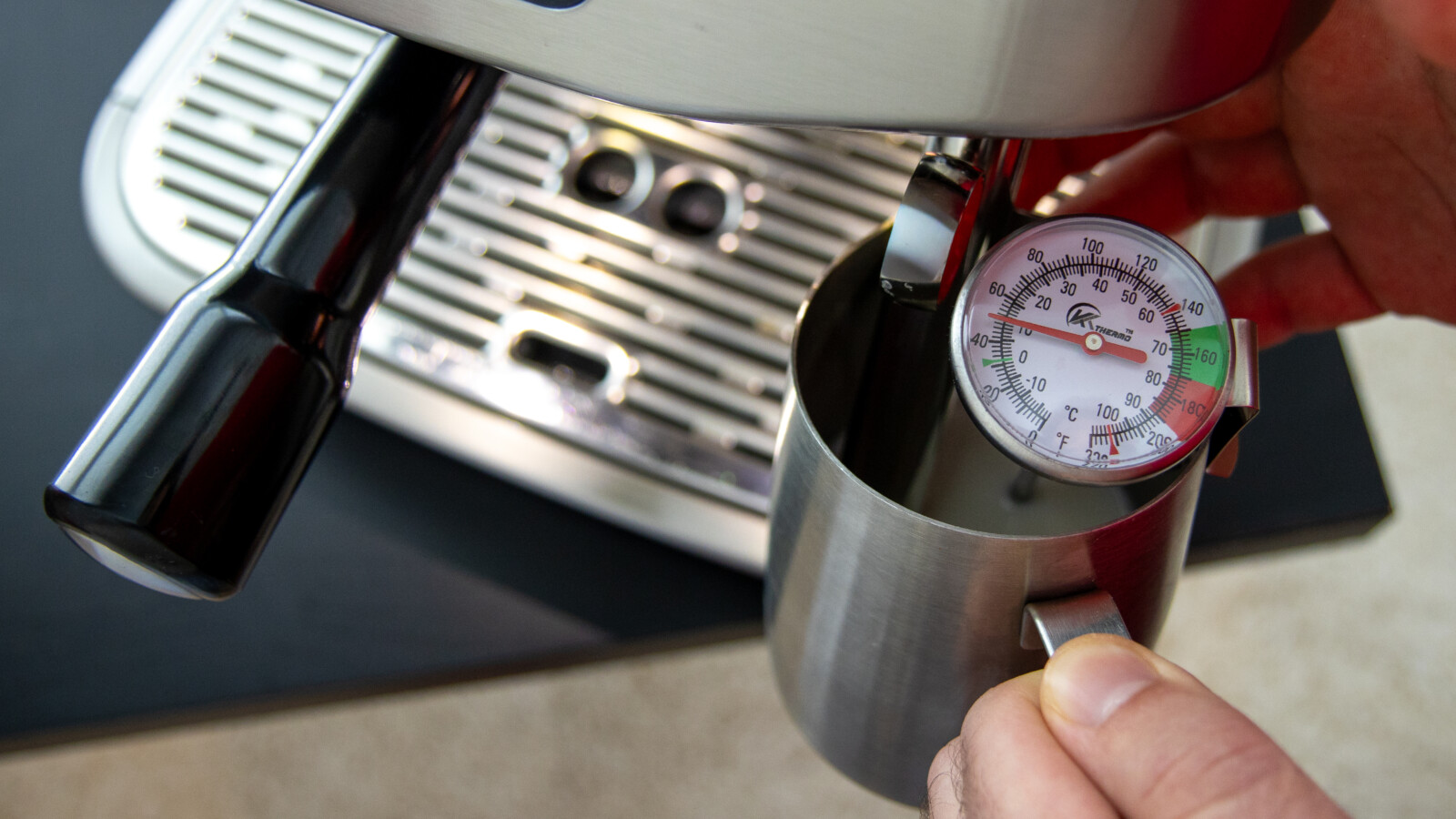
If your latte art keeps collapsing into a shapeless blob, the fix may cost just EUR 9. After years of confidently dialing in espresso shots and pour-over recipes, one step continued to trip me up: steaming milk. Too often, an overheated pour would ruin a carefully extracted shot. The solution turned out to be surprisingly simple: an attachable instant-read thermometer.
An analog or digital thermometer takes the guesswork out of milk steaming. As the milk swirls and hisses, you can watch the temperature climb and pull the steam wand away at exactly the right moment. That means no more stiff, scorched foam or flat, watery dairy. The model referenced here sells for about EUR 9 on Amazon.
How a thermometer guides milk steaming
Several tools can aerate milk, including handheld frothers, dedicated heated frothers, and the steam wands built into espresso machines. A thermometer can help with all three. Used with an espresso machine, a powerful boiler creates vapor almost instantly, forcing it into the milk through four holes in the wand.
Speed is the challenge. In roughly 30 seconds, cold dairy becomes fully aerated. A few seconds too long, and the emulsion breaks into runny milk and stiff foam. Baristas often advise stopping when the pitcher becomes too hot to touch, but that sensory cue can mislead. The pitcher can feel very warm early in the process, tempting you to steam longer and scald the milk.
A thermometer replaces that subjective step with a clear metric. Clip it to the side of the milk pitcher and watch the degrees rise. That visual rhythm frees you to concentrate on rolling the milk to build plenty of microfoam. Once the milk reaches 149 degrees Fahrenheit (65 degrees Celsius), the frothing is done.
Technique still matters
A thermometer solves timing, but it won’t fix poor form. Good frothing technique is still required for dense, workable foam. The aim is a foam of small, suspended bubbles, achieved by submerging the frothing tip at the correct depth to create a spinning vortex of milk. That vortex signals uniform aeration.
Placement is critical. Push the wand too deep and too little air enters, leaving a runny result. Keep it too high and the bubbles grow too large, sometimes sputtering out of the pitcher. To start the rolling motion, introduce the steam wand at an angle and just barely submerged, then let the milk expand as the temperature rises toward the target.
Combined with steady technique, the thermometer turns milk steaming into a repeatable process, hitting the 149-degree Fahrenheit mark for velvety, textured milk every time.