
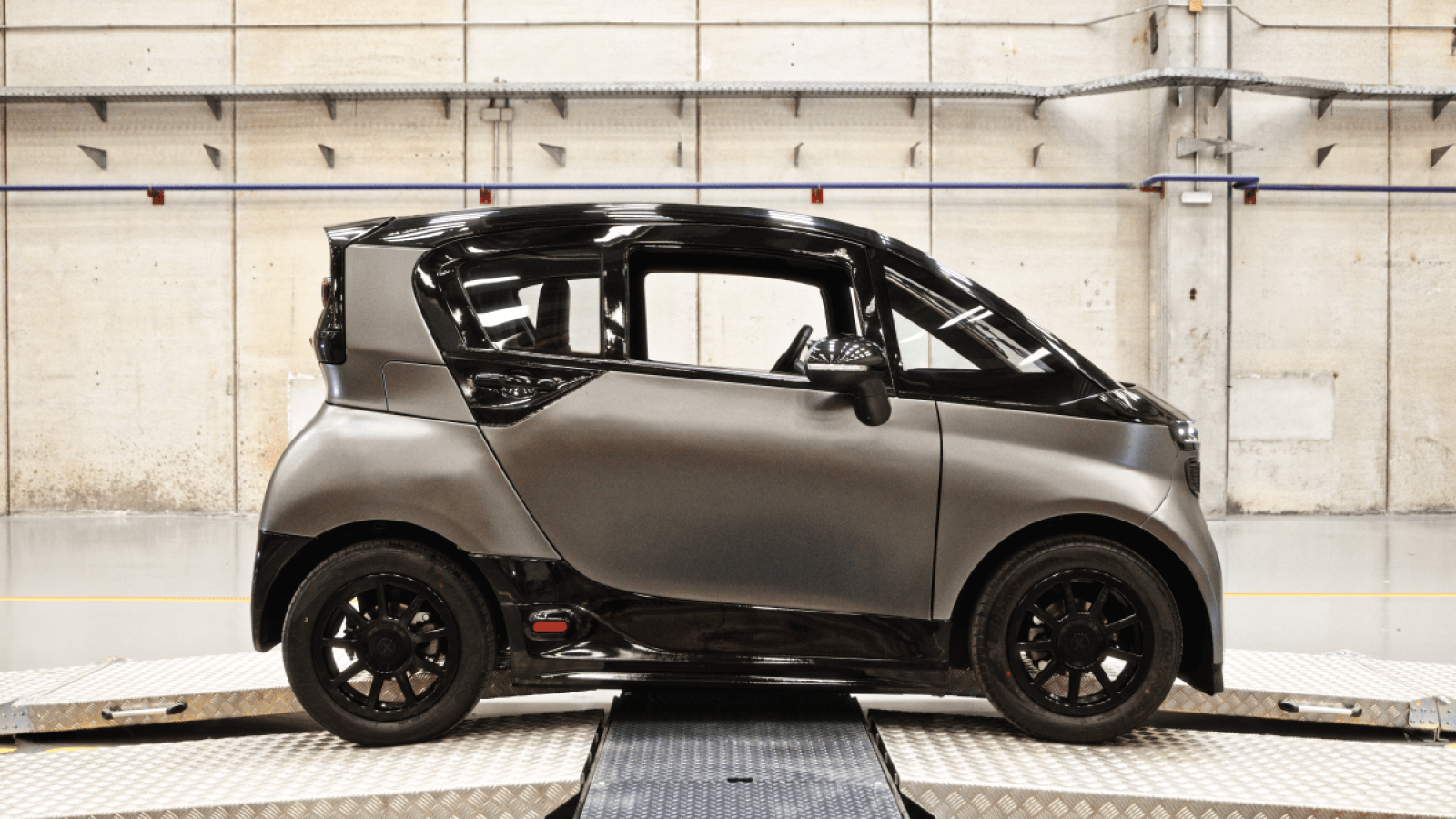
Vehicles on European streets are shrinking, and demand for microcars is climbing. Yet the compact Italian models that once defined the category have increasingly ceded ground to small Chinese electric vehicles. Even Smart, the iconic ultracompact brand, shifted its production to China. Now, Spanish startup Liux believes it can compete in this crowded field with a tiny electric car built around sustainability.
Following in the path of Switzerland’s Microlino, Liux is preparing to launch its microcar, the Liux Big. The name is a deliberate joke: the vehicle is small enough to park perpendicular to the curb, but it also reflects the outsized ambitions of a team that rarely takes the conventional route.
“The idea of a European car does not exist,” Liux co-founder Antonio Espinosa de los Monteros said, a striking statement from the CEO of a company whose cars have drawn attention for being “made in Spain.” Liux did open Spain’s first new car plant in more than 30 years. But Espinosa and co-founder David Sancho concluded that a fully sovereign supply chain is unattainable, so they are working within that reality while keeping sustainability as their guiding priority.
A Recyclable Design and Home-Charged Batteries
Liux’s batteries are not manufactured in Europe, but they can be recharged at home, including with electricity from solar panels. The car is designed to be easy to maintain and to resist the rapid obsolescence cycles common in modern vehicles. Most notably, its fiber body uses a novel linen-based biocomposite, engineered so the material can later be extracted and recycled.
“One thing that’s very clear for David and me is that recycling isn’t just a lab concept. You can recycle almost anything in a lab. What makes something recyclable has to do with how it’s built,” Espinosa said. “When you build something, you have to try to preserve the integrity of the material and the components so that a second life is possible.”
Espinosa’s focus on circularity traces back to his earlier work. He previously co-founded Auara, a Spanish B Corp that sells natural mineral water in bottles that are both recycled and recyclable. After a larger company acquired that brand, he launched a new venture with Sancho.
From the Animal Prototype to Europe-Wide Approval
Sancho leads the engineering side, specializing in electric vehicles designed to rival gas-powered cars. Before Liux, his most notable project was the Bóreas, a hybrid supercar unveiled at the 24 Hours of Le Mans in 2017. After a split with his former partners, he joined Espinosa to found Liux.
The company’s first prototype, the Animal, was a fully electric five-seater made almost entirely from recycled or plant-based materials. The founders unveiled the SUV in 2022 but pivoted soon after, determining that a smaller car would give them a far better chance of completing homologation.
By 2026, Liux has secured Europe-wide homologation for the Liux Big and expects to begin sales in the first half of next year.
Source
Image: techcrunch.com