
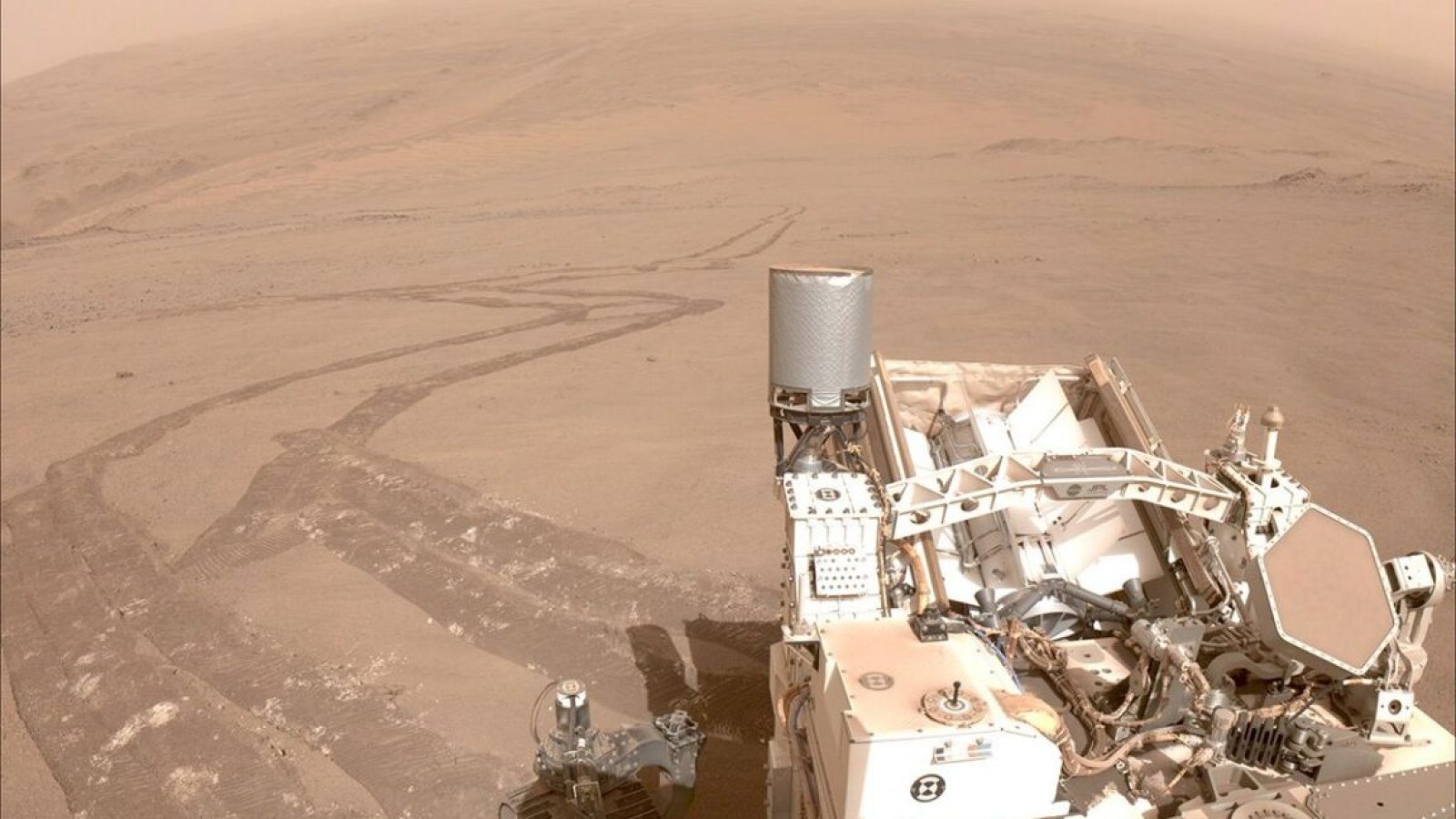
NASA’s Perseverance rover is set to establish a new record for the greatest distance ever driven by any vehicle on another world. Sometime next week, the rover will travel beyond 45.16km (28.06 miles) across the Martian surface, surpassing the previous mark held by the long-lived Opportunity rover, which ceased communications with NASA in 2018.
The automobile-sized rover landed on Mars in February 2021. Remarkably, it has reached this record-setting distance in roughly a third of the time it took its predecessor, a feat made possible by one particular piece of technology.
A rover that drives itself
“The real enabling technology has been its auto navigation system,” said Steven Lee, project manager for the Perseverance rover at NASA’s Jet Propulsion Laboratory.
Much like self-driving cars on Earth, Perseverance uses sophisticated onboard cameras to image the surrounding terrain. These images are then processed algorithmically by an onboard computer to calculate the safest route. Terrestrial vehicles enjoy certain advantages, such as clearly defined maps, street signs and lanes. Mars, by contrast, presents plenty of “road” hazards, from large boulders to sandy slopes, though at least Perseverance does not have to contend with other traffic or poor drivers.
The Curiosity rover, largely a twin of Perseverance that launched nine years earlier, had similar imaging capability and algorithms. However, its onboard computer was a generation older, with some of its chipset dating back to the 1990s, Lee said. As a result, only about 10 per cent of Curiosity’s driving has been autonomous, its processing capabilities being too slow. Across a decade and a half on Mars, Curiosity has driven 38.6km.
By comparison, around 90 per cent of the distance covered by Perseverance has been autonomous, thanks to its slightly more modern Vision Compute Element. This allows the vehicle to perform all of its sensing and computation while its wheels are turning. The rover is not travelling especially quickly, with a maximum wheel speed of about 150 metres per hour. Even so, because Perseverance has not needed to remain stationary waiting for navigation commands from drivers on Earth, it has been able to maximise its scientific return.
A science superstar on the Martian surface
“It is very enabling for the science,” said Vivian Sun, the mission’s deputy project scientist. “Not to sell the rover’s other advanced capabilities short, but the driving in particular has allowed us to have a larger scope than previous missions.”
The self-driving ability has complemented the mission well. Curiosity landed in Gale Crater and has slowly made its way up Mount Sharp, moving less and spending more time systematically taking detailed measurements as it gains altitude. Perseverance, however, landed in Jezero Crater, where its science objectives are more widely spread. It has been able to cruise between locations, frequently surprising scientists by arriving at new sites ahead of the planned timeline.
That efficiency matters, given how much work remains. In Jezero Crater, the rover is studying some of the most ancient rocks in the Solar System, older than any on Earth, dating back roughly 4 billion
Source
Image: arstechnica.com